Reports
How do I take off quantities without missing half the job?
The losing quote usually is not wrong about rates, it is wrong about quantities: the wall measured once instead of twice, the plaster counted but not the beads, the muck-away forgotten entirely. Take-off errors are silent, systematic and all in the same direction: yours.
QScope Team·28 November 2025·5 min read
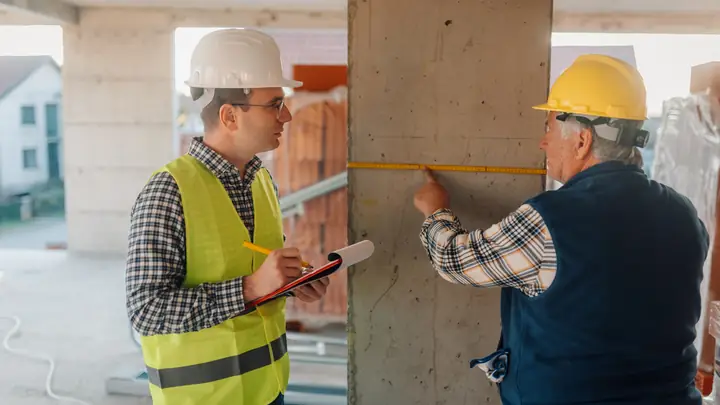
Taking off is turning drawings into a list of measured quantities you can price: so many square metres of blockwork, so many linear metres of skirting, so many number of doorsets. The professionals do it under measurement conventions (the current one is NRM); at kitchen-table scale you do not need the rulebook, you need its three habits.
Habit one: a fixed route, so nothing hides
Never measure by hunting around the drawing for things to count. Work in a fixed order through the building, the classic is bottom up: substructure, frame or walls, roof, external envelope, internal divisions, finishes, services, external works, and within each element, one trade at a time. The route is what finds the items that hide from hunting: measuring “the extension” misses things, measuring “every wall, then every floor, then every ceiling” does not, because the route visits everything once and nothing twice.
Habit two: dims on paper, arithmetic separate
Write the dimensions down as you lift them, labelled with where they came from (“kitchen N wall, drawing 04 rev B”), and do the multiplication in a separate column. Two reasons, both learned expensively: a written dim sheet can be checked, by you in a fortnight or by anyone else, while a number typed straight into a total can only be believed; and when the drawings change, revision C moves the kitchen wall, you can see exactly which quantities the change touches instead of re-measuring the job. Date the take-off and name the revisions it used: that one line settles half of all was-it-included arguments and prices the variation when revision C lands.
Habit three: the checklist of what amateurs miss
The expensive omissions are rarely the walls; they are the things drawings do not draw:
- Labours on the measured work: the beads, stops and reveals on the plaster, the cutting at openings, the corners and ends on everything linear.
- Muck-away and disposal: everything dug has to leave, at a price per load someone must have counted.
- The invisible trades: DPCs and membranes, insulation in things, fire-stopping, lintels, wall ties, movement joints.
- Waste, openings and laps done consistently: pick a rule per material (deduct openings or not, add lap percentages) and apply it everywhere, inconsistency is worse than either convention.
- Access and protection: the scaffold, the floor protection, the temporary works, which belong in the preliminaries but get remembered at take-off or not at all.
When drawings are not really drawings
Half of domestic work is priced off a plan, an elevation and a conversation. Take off what is drawn, and convert everything undrawn into named assumptions in the quote, “assumes strip foundations at 1m; assumes no steel beyond the two shown”, or into provisional sums. The take-off cannot invent information; its job is to make the missing information visible instead of silently priced at zero.
What to do this week
1. Build your route checklist once, elements in your fixed order with the invisible-items list per element, and use it on every future take-off.
2. On the next quote, keep the dim sheets, labelled and dated, filed with the quote.
3. Compare your last job’s take-off against what you actually bought, one evening: the gaps you find are your personal systematic error, and they will be in the next quote too until measured.
Where the information stops
On a job big enough that a take-off error is company-threatening, buying a measured bill from a quantity surveyor is purchasing exactly this discipline at professional speed, and checking their bill against your own route checklist is still worth your evening: two independent measurements agreeing is the only real verification there is.