QScope

Dayworks

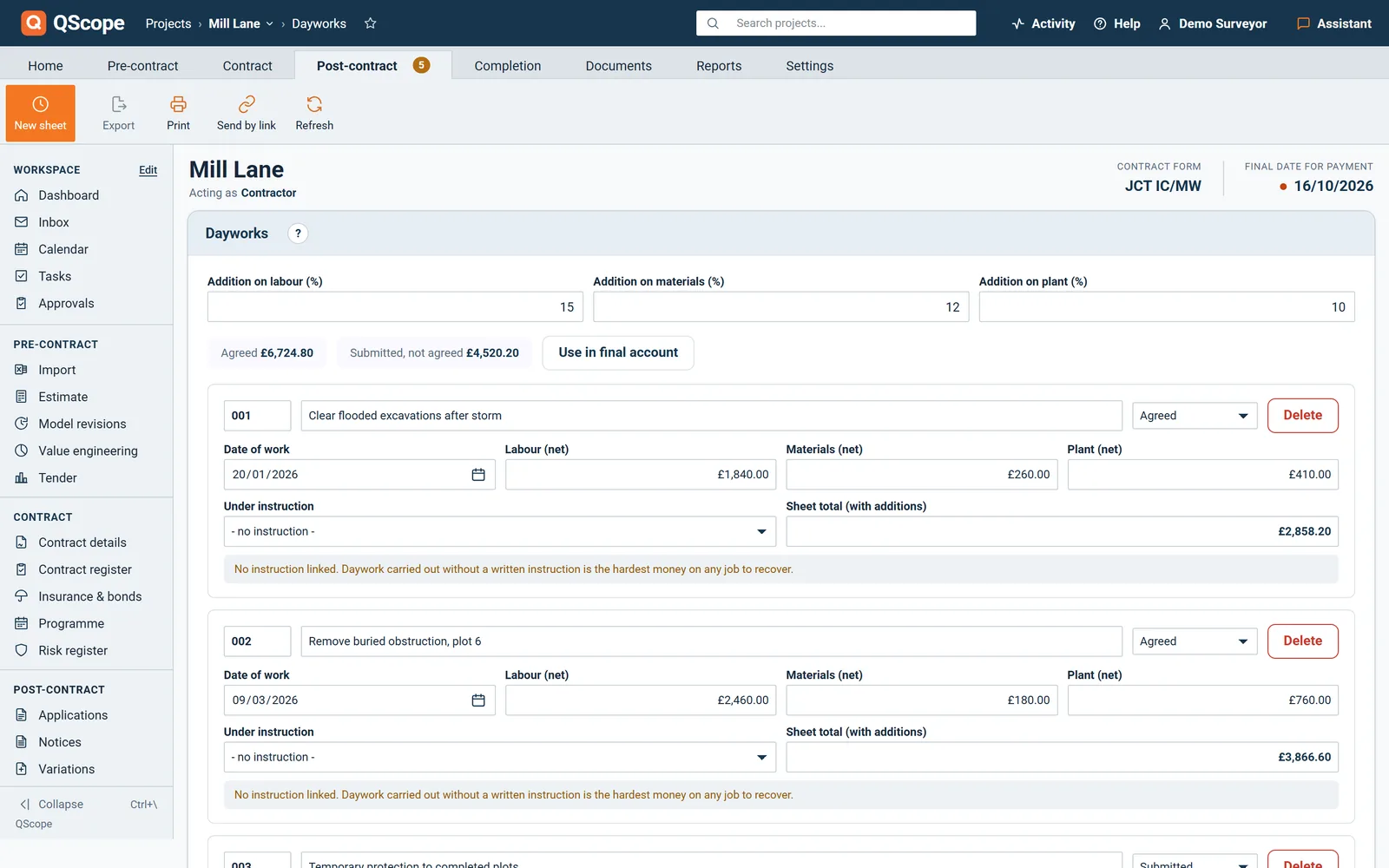
Three percentages, not one

The contract states separate additions for labour, materials and plant. Applying an average to the lot is quick, and it is the reason the sheet comes back with a query instead of a signature.

  • Contract clause set to FIDIC 13.6 on the variation record
  • Resources recorded against the Daywork Schedule in the Contract
  • Certified total carried into the monthly Statement, not entered twice

30 days free, no card.

Variations
VO-09 valued as daywork, FIDIC 13.6
Basis of valuationDaywork
Contract clauseFIDIC 13.6
Labour, per Daywork Schedule£9,400
Materials, per Daywork Schedule£12,600
Plant, per Daywork Schedule£2,300
Sheet total£24,300

The total is certified in the monthly Statement; the Interim Payment Certificate follows within 28 days and the Employer pays within 56 days of the Statement, all in calendar days. The figures are published starting points to verify against the Particular Conditions.

FIDIC values daywork under Sub-Clause 13.6

The same idea has a different anchor on a FIDIC contract.

Where a variation is of a minor or incidental nature, the Engineer may instruct that it be valued on a daywork basis under Sub-Clause 13.6, priced against the Daywork Schedule in the Contract rather than against three contract percentages. The Contractor keeps records and vouchers of the resources used, and the value is certified through the ordinary monthly Statement. QScope holds the same sheet under a FIDIC contract form, with the clause set to 13.6 rather than a JCT reference, and carries the certified total into the Statement so the daywork runs down the FIDIC payment timetable rather than a separate one. Certificate and payment dates on FIDIC are counted in calendar days, and QScope shows them as published starting points to verify against the Particular Conditions.

Dayworks

Each addition applied to its own element

The percentages differ because they cover different things.

  • Separate additions for labour, materials and plant
  • Sheet total shown with the percentages that produced it
  • Submitted, agreed, disputed and rejected held as separate states
Dayworks
Sheet DW-014
Labour £2,000 + 130%£4,600
Materials £3,000 + 15%£3,450
Plant £500 + 20%£600
Sheet total£8,650

A single blended addition of 55 per cent on the same sheet gives £8,525. Close enough to look right, far enough apart to be argued about.

Dayworks

Agreed is not the same as submitted

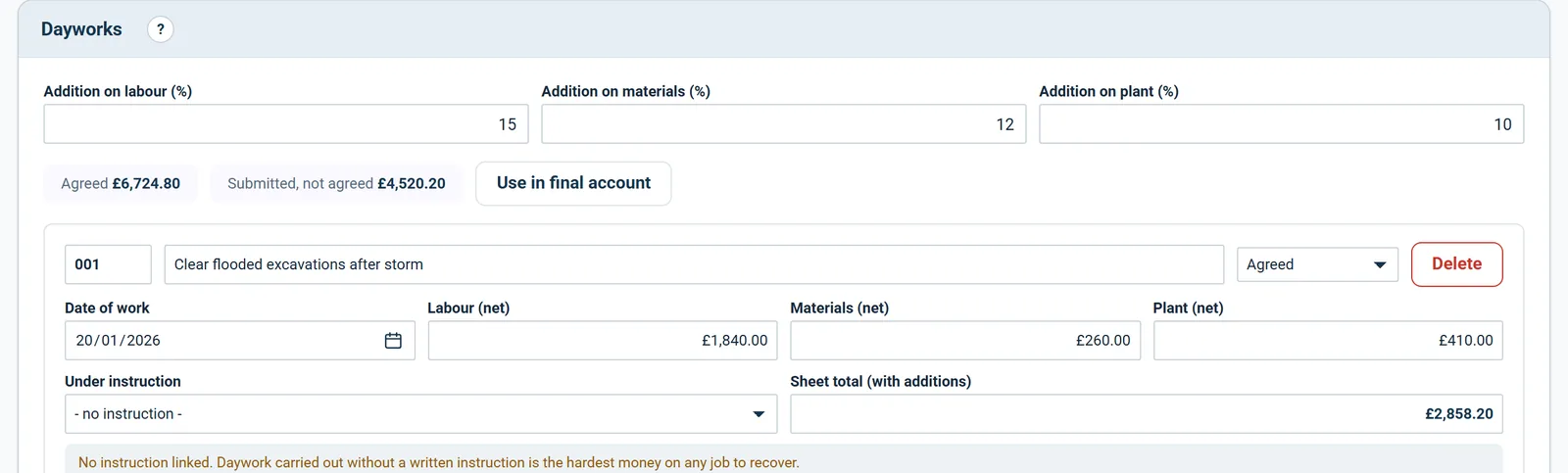
Only sheets marked as agreed are carried into the final account.

  • Agreed total and submitted total shown separately
  • One click carries the agreed total to the dayworks line of the final account
  • Daywork schedule prints with the additions stated
Dayworks
Position
Agreed
£18,420
Submitted
£6,900
Sheets
14
Carried to final account£18,420
Awaiting agreement£6,900
Sheets without an instruction2

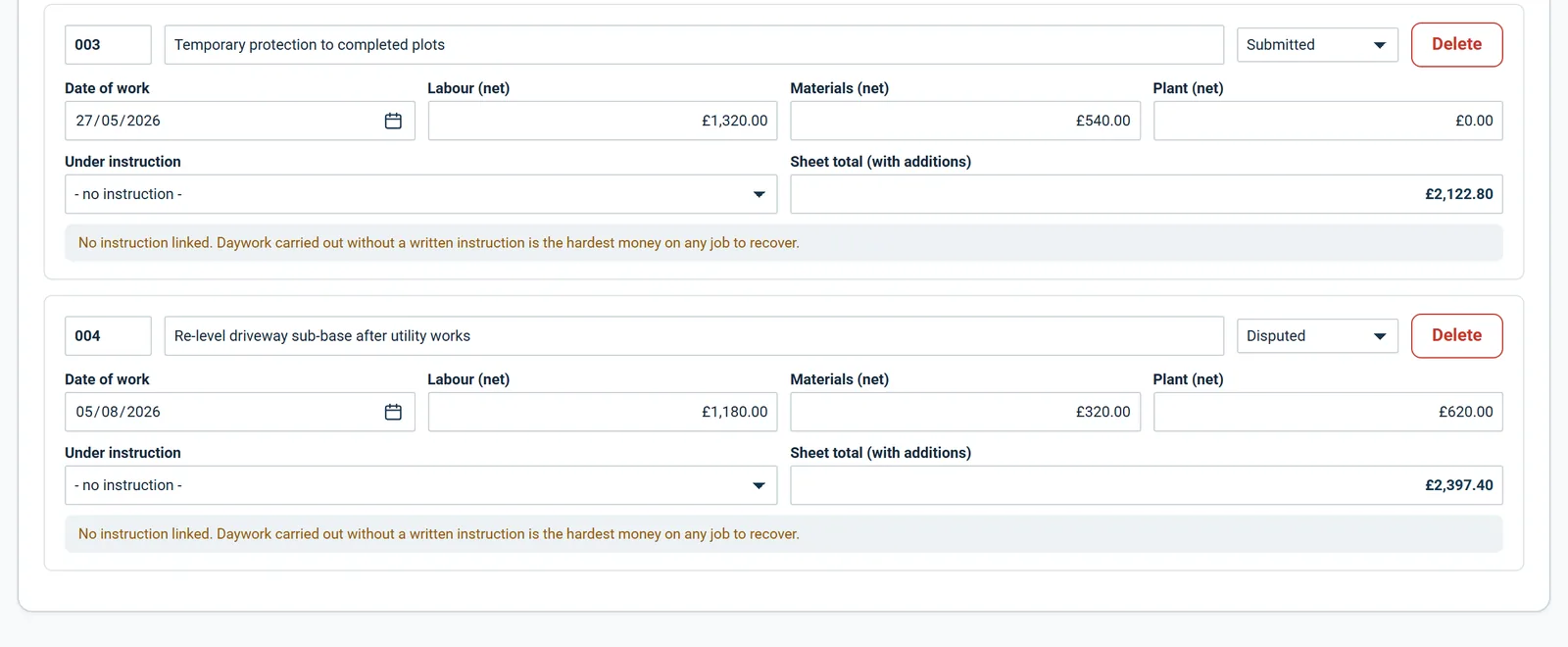
Daywork carried out without a written instruction is the hardest money on any job to recover, so those sheets are flagged rather than quietly totalled.

See it running before you sign up

Variations

Daywork is a way of valuing a variation

Daywork is not a separate kind of change.

  • Basis of valuation set to daywork on the variation record
  • Contract clause recorded, so the route is on file
  • Sheet total carried into the variation, not entered twice
Variations
VO-09 valued by daywork
Basis of valuationDaywork
Contract clauseJCT 5.7
Sheets linkedDW-014
Extension of timeNone
Value£8,650.00

Sheet DW-014 totals £8,650, and that is the value carried into VO-09. The variation records why daywork was used rather than a measured rate.

Instructions

No instruction, no daywork

A daywork sheet with no instruction behind it is the hardest money on any job to recover.

  • Each sheet links to the instruction that authorised the work
  • Sheets with no instruction linked are flagged
  • Architect’s instruction, CVI and site instruction all recorded
Instructions
Authority behind DW-014
TypeArchitect’s instruction
ReferenceAI-022
Date issued5 Aug 2026
Cost effectYes
Sheets against itDW-014

A daywork sheet with no instruction against it is flagged rather than quietly totalled, because unauthorised daywork is rarely recovered.
Client Valuations

Agreed dayworks reach the client through the certificate

An agreed daywork total is not paid on the side.

  • Agreed daywork total certified as a valuation line
  • Retention deducted once, in the certificate, as JCT expects
  • Previously certified and this period calculated as you type
Client Valuations
Dayworks on PC-04
DescriptionThis valThis period
DW-014 valued as VO-09100 %£8,650.00
DW-011 agreed earlier100 %£0.00
Agreed dayworks this period£8,650.00
Less retention at 5%(£432.50)
Net on this line£8,217.50

QScope carries the agreed total into the certificate as a normal line, so the client sees a valuation that adds up rather than a separate invoice arriving out of sequence.

Who it is for

One change, four people it touches

You are applying

You price the change and defend it

You price the instruction, submit the variation and defend it when it comes back cut. Instructed work with no variation against it is money you have already spent.

Applying for payment
the same measurement

You are certifying

You value the change and answer for it

You value the variation from the other chair and account for what you cut. The register you keep is the one the final account will be argued from.

Certifying payment

You are doing both

You build the change, paid or not

You absorb the small changes as they come, and the ones nobody wrote down are the ones you end up building for free.

Doing both yourself

You are reporting

You fund the change, priced or blind

You check that scope changes are priced and approved before money moves, because an unpriced variation is risk the facility is carrying blind.

Recommending a drawdown

The client, the architect and the tenderer are not on this list. They are the people you let in on a link: they see the one document you sent them, answer it, and that answer is written into the record. No account, no licence, no charge, on every plan.

FAQs

The questions this page raises most often, answered without a sales pitch at the end.

Only where the work cannot properly be valued by measurement at contract rates. Where a rate exists, the rate applies. Daywork is not a choice between two ways of valuing the same work.

Your contract particulars. Enter them once per project and every sheet uses them.

Where the contract adopts the RICS definition of prime cost of daywork, that document decides. A percentage applied to the wrong base is wrong however carefully it is applied.

Yes, in the files area against the project. Contemporaneous signed records are what make daywork recoverable.

Not exactly. Under FIDIC a variation of a minor or incidental nature can be instructed on a daywork basis under Sub-Clause 13.6, priced against the Daywork Schedule in the Contract and certified through the ordinary Statement and payment certificate cycle in calendar days. QScope records the clause as 13.6 and runs the FIDIC timetable rather than the Construction Act one. Statutory dates are published starting points to verify locally.

From the blog

The part nobody teaches you, written down

Three pieces from the same corner of a contract as this page, answered at length and without a sales pitch at the end.

All 174 pieces

Keep reading

The three parts this page leans on

Three percentages, not one

The contract states separate additions for labour, materials and plant. Applying an average to the lot is quick, and it is the reason the sheet comes back with a query instead of a signature.

30 days free, no card.

Rather ask first? Write to help@qscope.co.uk and you will get a reply within one working day, Monday to Friday.