Bonds and warranties
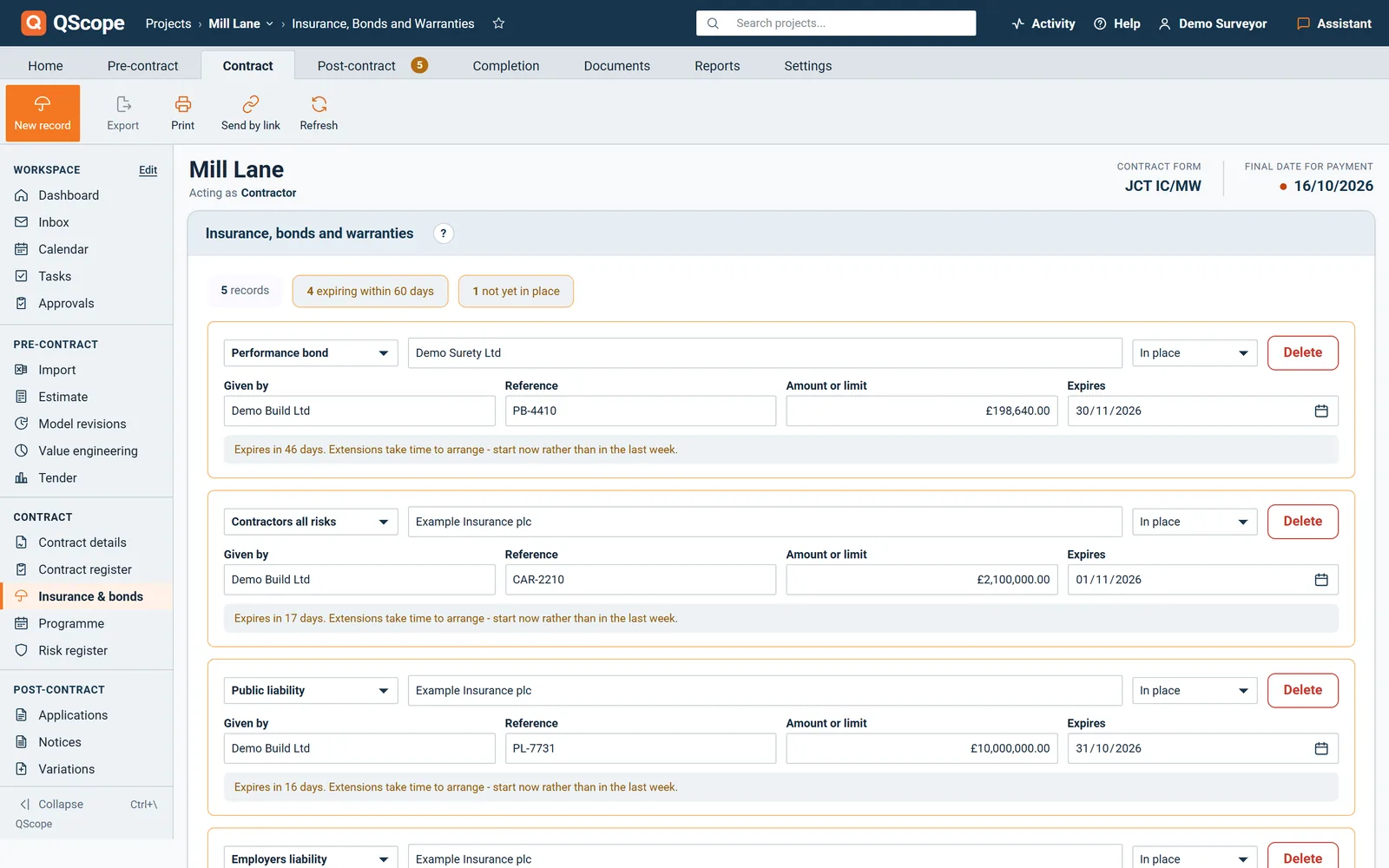
A performance bond that lapsed before practical completion, and a collateral warranty nobody ever executed, are both discovered at exactly the same moment: the one you needed them.
30 days free, no card.
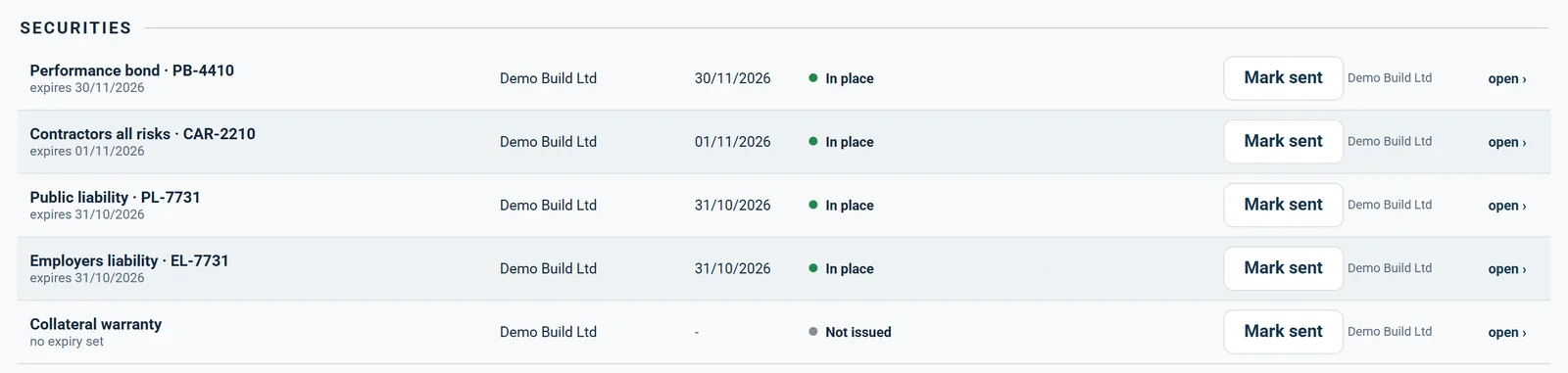
Three records are not yet in place. On a project where the security was priced into the deal, that is three obligations nobody can currently enforce.
The commonest gap is not an expiry at all.
It is a bond that was asked for at contract stage, chased twice, and never arrived. Nobody notices because there is no document to file and therefore nothing missing from the file. QScope counts requested and draft records separately from those in place, so the absence is visible as a number rather than as silence.
Bonds and warranties
Bonds and policies have end dates, and those end dates are set at a point when the programme looked different.
The advance payment bond expired while the advance was still being recovered. Until it is reinstated the security for that money no longer exists.
Advance payments
An advance payment bond is the security behind money paid before the work is built in.
The advance payment bond expired on 2 Aug 2026 with £27,000 still to recover. Until it is reinstated the security for that money no longer exists.
Retention
A retention bond lets the contractor substitute security for cash retention, so the money is released and the bond stands in its place.
The bond has to outlast the retention it replaces. This one expires a week after the rectification release, which is the margin the register checks.
Project record
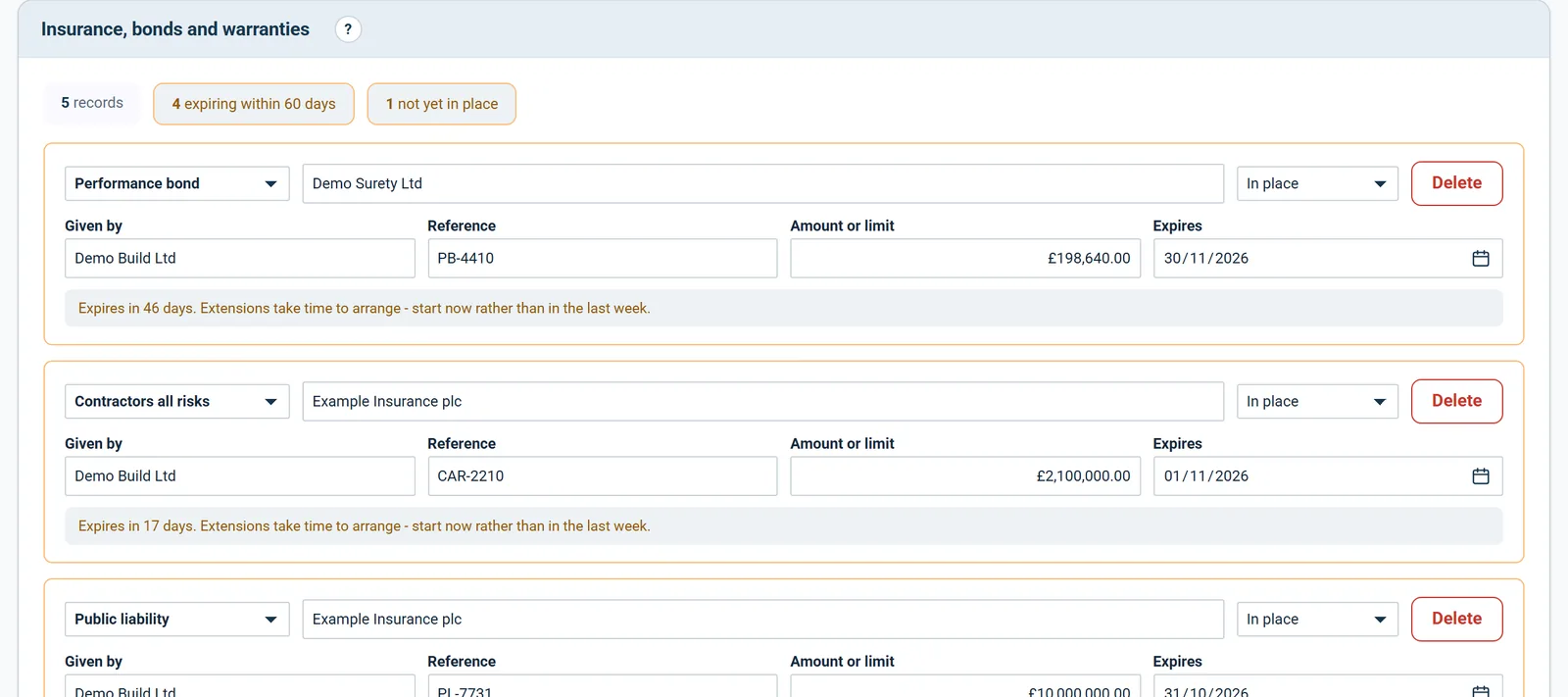
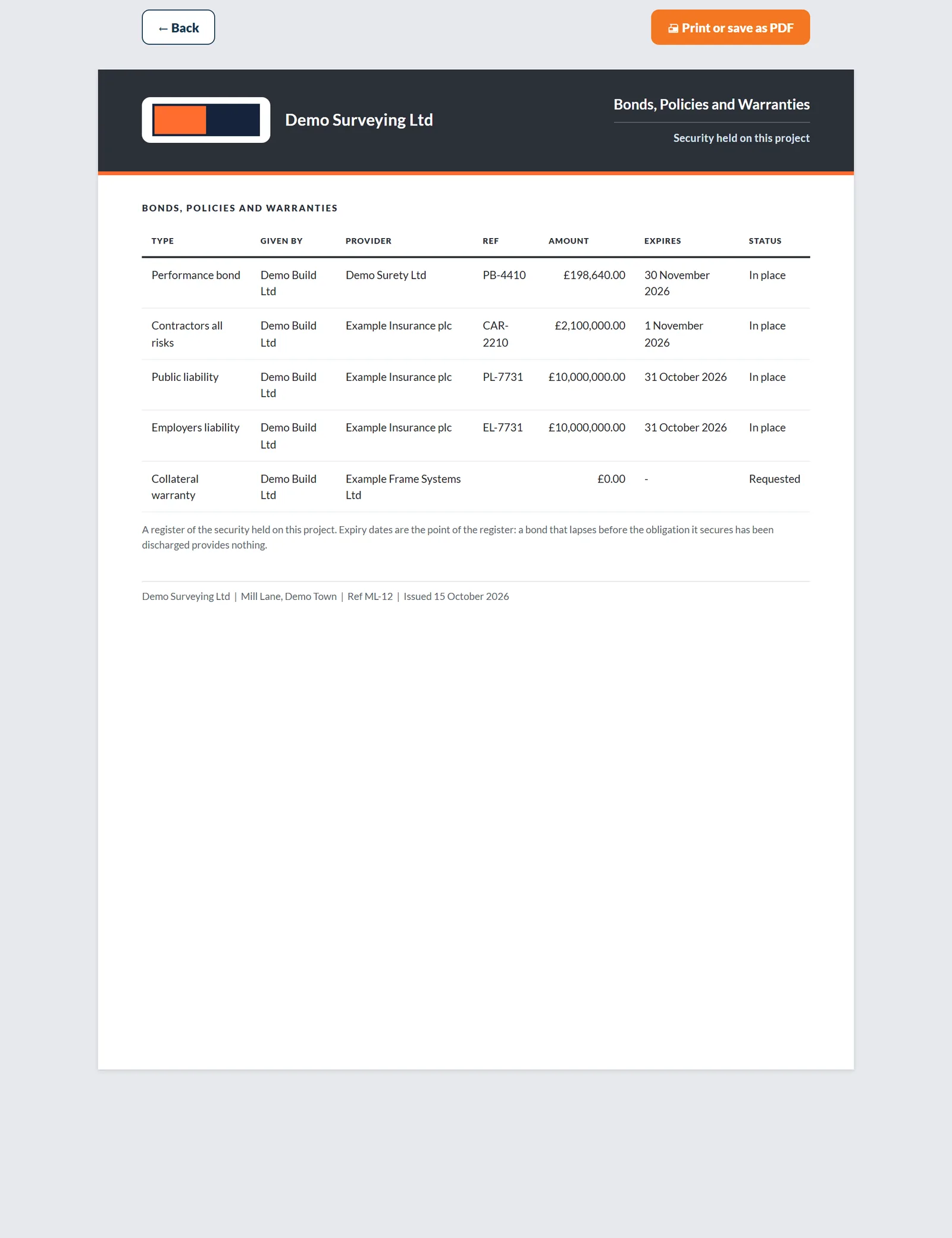
The register holds the dates, the amounts and the status.
QScope keeps them against the same project as the register, so when the security is called on the wording is to hand rather than somewhere in an email from two years ago.
Bonds and warranties
On a FIDIC job the security is the Performance Security under Sub-Clause 4.2 and, where an advance is paid, the advance payment guarantee under Sub-Clause 14.2.
The Performance Security has to outlast the Defects Notification Period, and the advance payment guarantee has to cover the advance still to recover. Both are read on their expiry dates.
Who it is for
You are applying
The record defends your own figuresYou keep the record that defends your own applications: who changed which figure, and the documents behind every line.
Applying for paymentYou are certifying
The trail holds when yours are challengedYou certify on the strength of the record, and when a figure is challenged the audit trail is what stands between you and an argument.
Certifying paymentYou are doing both
The file protects the one who kept itYou keep the paperwork yourself, and the file that assembles as you go is the one that protects you when memories differ.
Doing both yourselfYou are reporting
The record is all the site you seeYou rely on the record more than anyone: bonds in force, access controlled, every figure traceable, because you were never on site.
Recommending a drawdownThe client, the architect and the tenderer are not on this list. They are the people you let in on a link: they see the one document you sent them, answer it, and that answer is written into the record. No account, no licence, no charge, on every plan.
The questions this page raises most often, answered without a sales pitch at the end.
Store the executed document in the project files area. The register holds the dates, amounts and status, which is what needs watching.
Because a bond extension needs a request, an underwriting decision and an execution, and that rarely happens in a fortnight. Sixty days leaves room for the process to go wrong once.
Yes. The register is per project and covers security given by anyone on it, with the giving party recorded against each entry.
No. It is a record of what exists and when it ends. Whether the cover is adequate is a question for whoever arranged it.
Yes. It tracks the Performance Security under Sub-Clause 4.2 and the advance payment guarantee under Sub-Clause 14.2 the same way as their UK equivalents, on their expiry dates and against what they secure. On Gulf and FIDIC jobs these are the standard instruments.
From the blog
Three pieces from the same corner of a contract as this page, answered at length and without a sales pitch at the end.
An advance payment bond is a guarantee that if you take the money and fail, the client gets it back from a bank or surety instead of chasing you. What it costs, how it reduces as the advance is recovered, and the wording that quietly makes it dangerous.
Read nowInstead of the client holding 5% of every payment for two years, a surety guarantees the same protection and you keep the cash. When the swap genuinely pays, what the premium and the counter-indemnity really cost, and the client objections worth taking seriously.
Read nowTitle to site materials passes to the employer once their value is certified and paid. But a contractor can pass only the title it holds, and a supplier's retention of title clause can defeat the employer even after payment.
Read nowKeep reading
A performance bond that lapsed before practical completion, and a collateral warranty nobody ever executed, are both discovered at exactly the same moment: the one you needed them.
30 days free, no card.
Rather ask first? Write to help@qscope.co.uk and you will get a reply within one working day, Monday to Friday.