QScope

Materials on site

Paid for once, recovered automatically

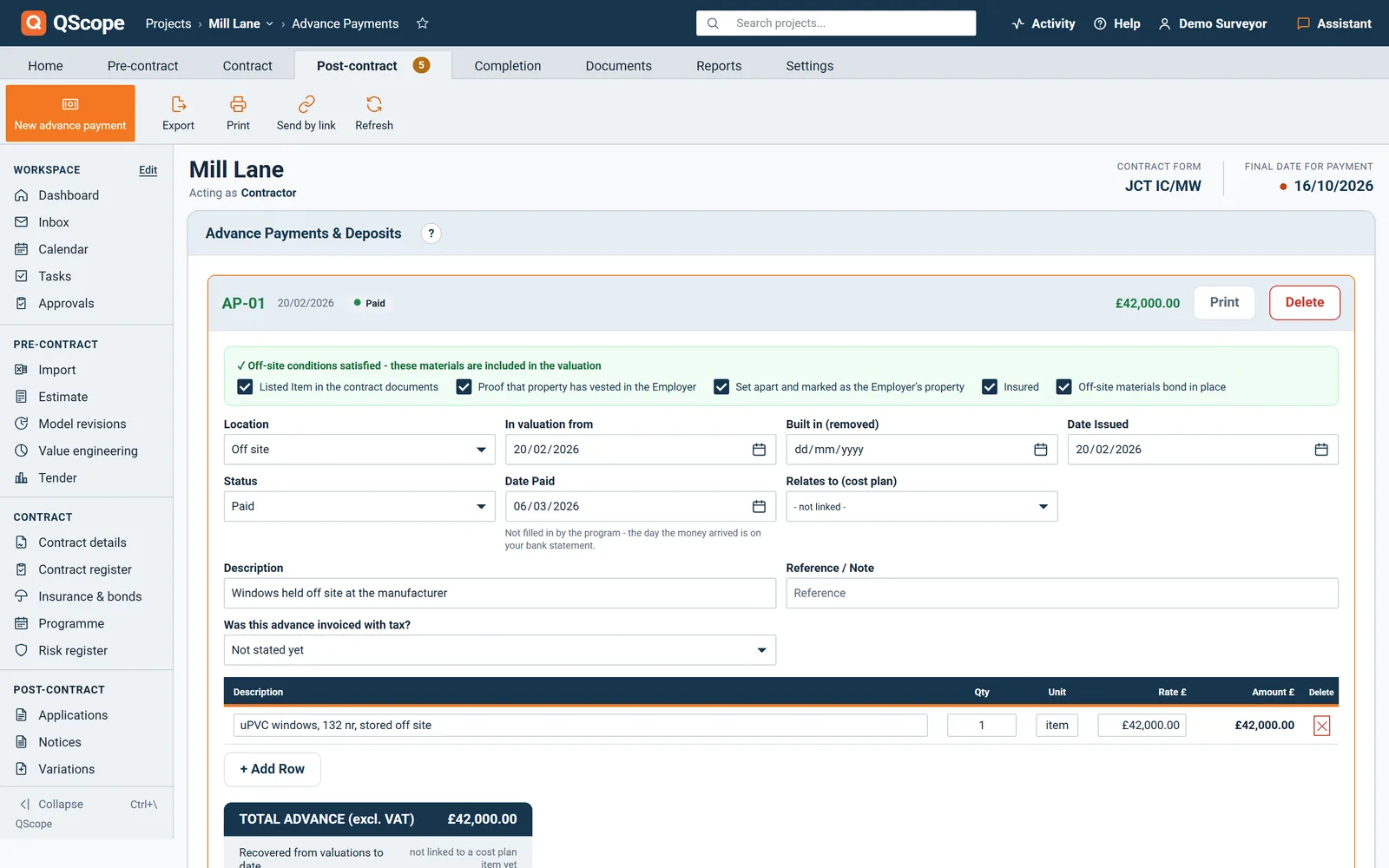
Materials delivered but not yet built in still have to be paid for, then recovered as the work is certified. Doing that from memory is how a contractor ends up paid twice for the same brick.

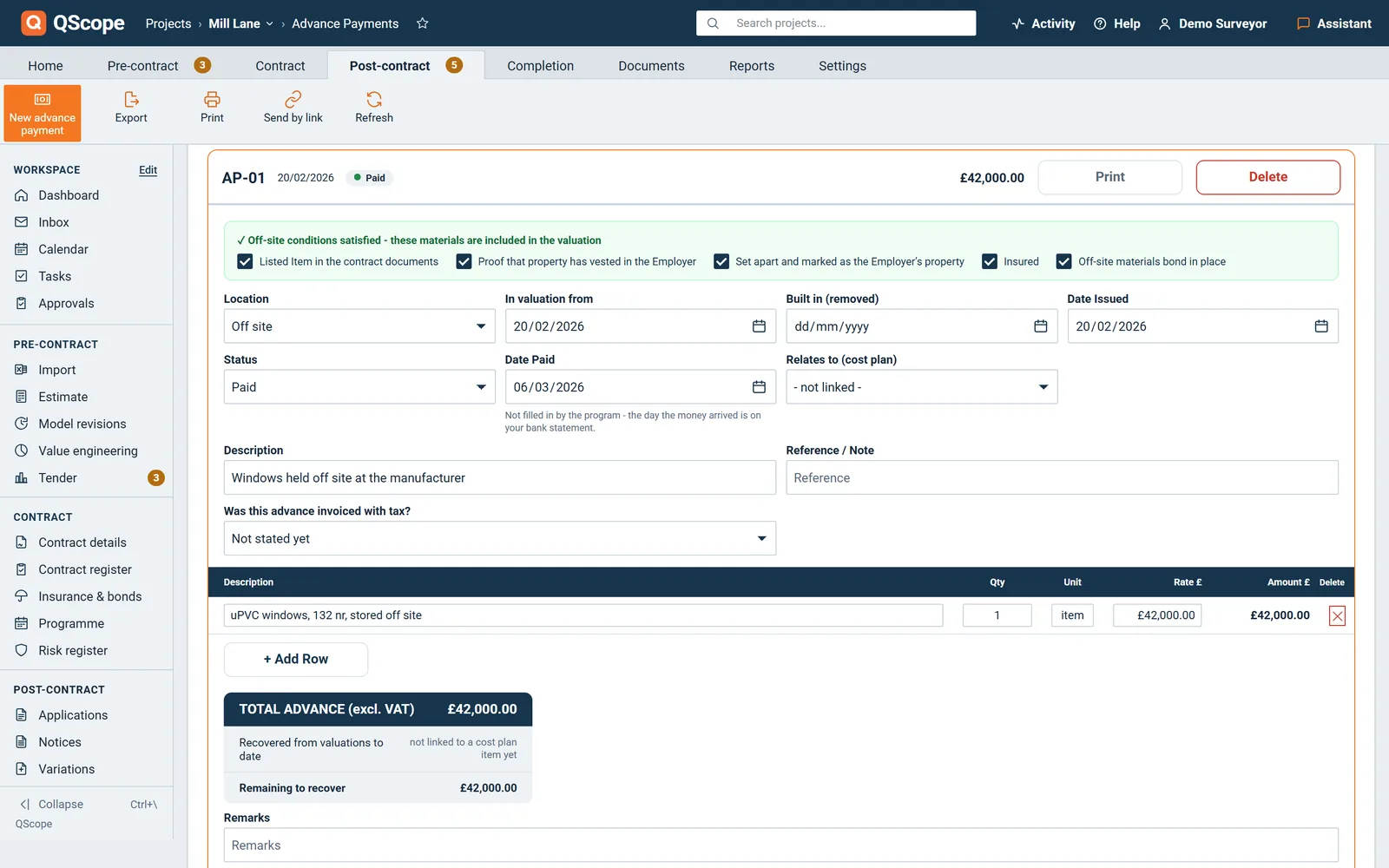
  • Description, quantity, rate and total, like any other priced item
  • Linked to the bill line the materials relate to
  • Status from provisional through confirmed to paid

30 days free, no card.

Advance Payments
AP-01 Structural steel on site
Relates to2.02 Structural steel frame
Date issued12 Jun 2026
StatusPaid
Advance value, excl VAT£12,500.00
VAT at 20%£2,500.00
Total paid£15,000.00

Once linked, QScope knows that when that line is certified, part of the money has already been paid.

Record it against the line it belongs to

An advance floating loose in a spreadsheet is a number waiting to be forgotten.

Linking it to the bill line it relates to is what makes recovery automatic instead of manual. Once linked, QScope knows that when that line is certified, part of the money has already been paid.

Client Valuations

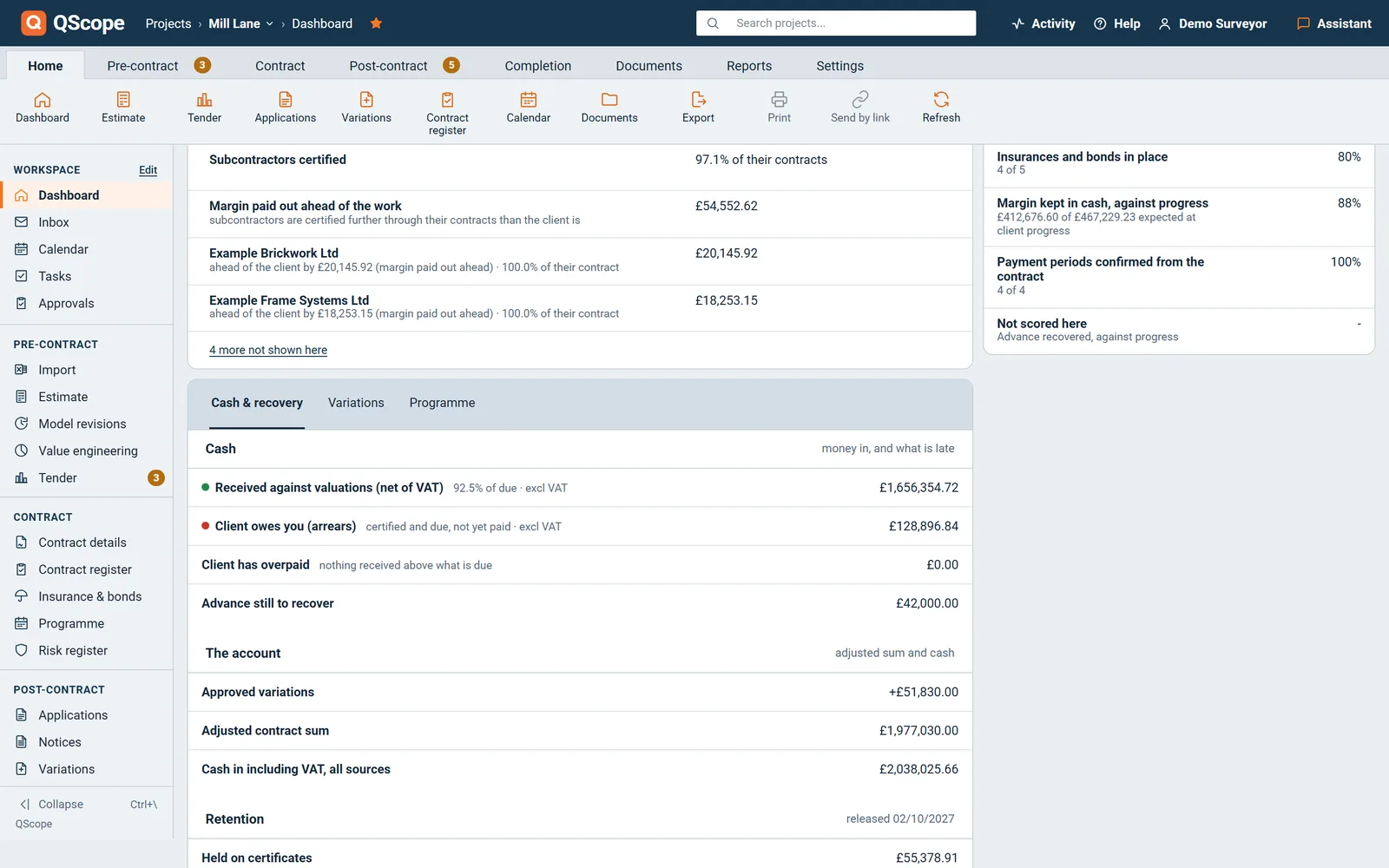
Recovery happens as the work is certified

You do not track it.

  • Recovered in proportion to the work certified on that line
  • Shown on the certificate as a note against the line, not buried
  • Outstanding balance visible at any time
Client Valuations
Recovery on PC-04
2.02 Structural steel frame, 62% certified£18,600.00
Includes advance £7,800.00 for materials on site
Advance value£12,500.00
Recovered to date(£7,800.00)
Outstanding£4,700.00

You do not track it. As the linked line is valued in following certificates, the advance is drawn back automatically, and the certificate shows what is happening rather than hiding it inside a total.

Bonds and warranties

The bond that secures the advance

Where a contract requires it, an advance is paid against an advance payment bond, and the bond only needs to cover what has not yet been recovered.

  • Advance payment bond tracked on its expiry date
  • Cover required read against the outstanding advance
  • Sixty-day warning before the bond lapses
Bonds and warranties
Advance payment bond
Bond value£12,500.00
Advance recovered to date(£7,800.00)
Cover still required£4,700.00

The bond covers the advance still to be recovered. As the structural steel line is certified the outstanding balance falls and the cover required falls with it.

See it running before you sign up

Payment

The advance notice keeps the statutory timetable

An advance payment notice is a payment like any other, and it sits on the same statutory timetable as an interim certificate.

  • Final date for payment and pay-less deadline counted from the due date
  • Contract form sets the day counts, weekends and bank holidays excluded
  • Dates printed on the advance payment notice, not just on screen
Payment
Statutory dates, JCT SBC/DB
Due date15 Aug 2026
Last date for payment notice due + 520 Aug 2026
Last date for a pay-less notice final - 524 Aug 2026
Final date for payment due + 1429 Aug 2026

The advance payment notice runs on the same Construction Act timetable as the interim certificates, counted from the same due date.

Advance Payments

FIDIC handles it under 14.2 and 14.5

The two ideas on this page map onto two different FIDIC clauses.

  • Advance payment under 14.2 secured by an advance payment guarantee
  • Repaid by percentage deductions from later certificates, not per line
  • Plant and Materials for the Works certified under 14.5
Advance Payments
14.2 advance, repaid by deduction
Contract clauseFIDIC 14.2
Advance payment£500,000
Secured byAdvance payment guarantee
RepaymentDeduction from each IPC
Outstanding£320,000

Under FIDIC the advance is a loan against a guarantee, repaid by deductions from later Interim Payment Certificates, not recovered against one bill line. Payment for Plant and Materials for the Works is certified separately under 14.5. Figures are published starting points to verify against the Particular Conditions.

Who it is for

Four chairs, one valuation on the table

You are applying

You value it, and the certificate cuts it

You value the work line by line and submit the application. When the certificate lands short, the difference is argued line by line too, and your valuation is the evidence.

Applying for payment
the same measurement

You are certifying

You cut it, and you sign your name

You value the same lines from the other chair and issue the certificate. Every percentage you cut has to survive the question of why, a month or a year later.

Certifying payment

You are doing both

You value your own work, alone

You price it, you value it and you apply for it yourself, between site visits. The certificate still has to add up as if a surveyor had built it.

Doing both yourself

You are reporting

You certify value the lender pays on

You certify value in place so the lender can release the next tranche. The valuation is the same arithmetic; the reader was never on site.

Recommending a drawdown

The client, the architect and the tenderer are not on this list. They are the people you let in on a link: they see the one document you sent them, answer it, and that answer is written into the record. No account, no licence, no charge, on every plan.

FAQs

The questions this page raises most often, answered without a sales pitch at the end.

No. A variation changes the works. An advance pays early for works already in the contract, because the materials are on site and the contractor has bought them. It does not change the contract sum.

It follows your contract. Many contracts do not retain against materials on site, since retention secures workmanship rather than delivery. Set it to suit the terms you are working under.

The advance stays outstanding and carries into the final account, where it is settled with everything else. Nothing disappears quietly.

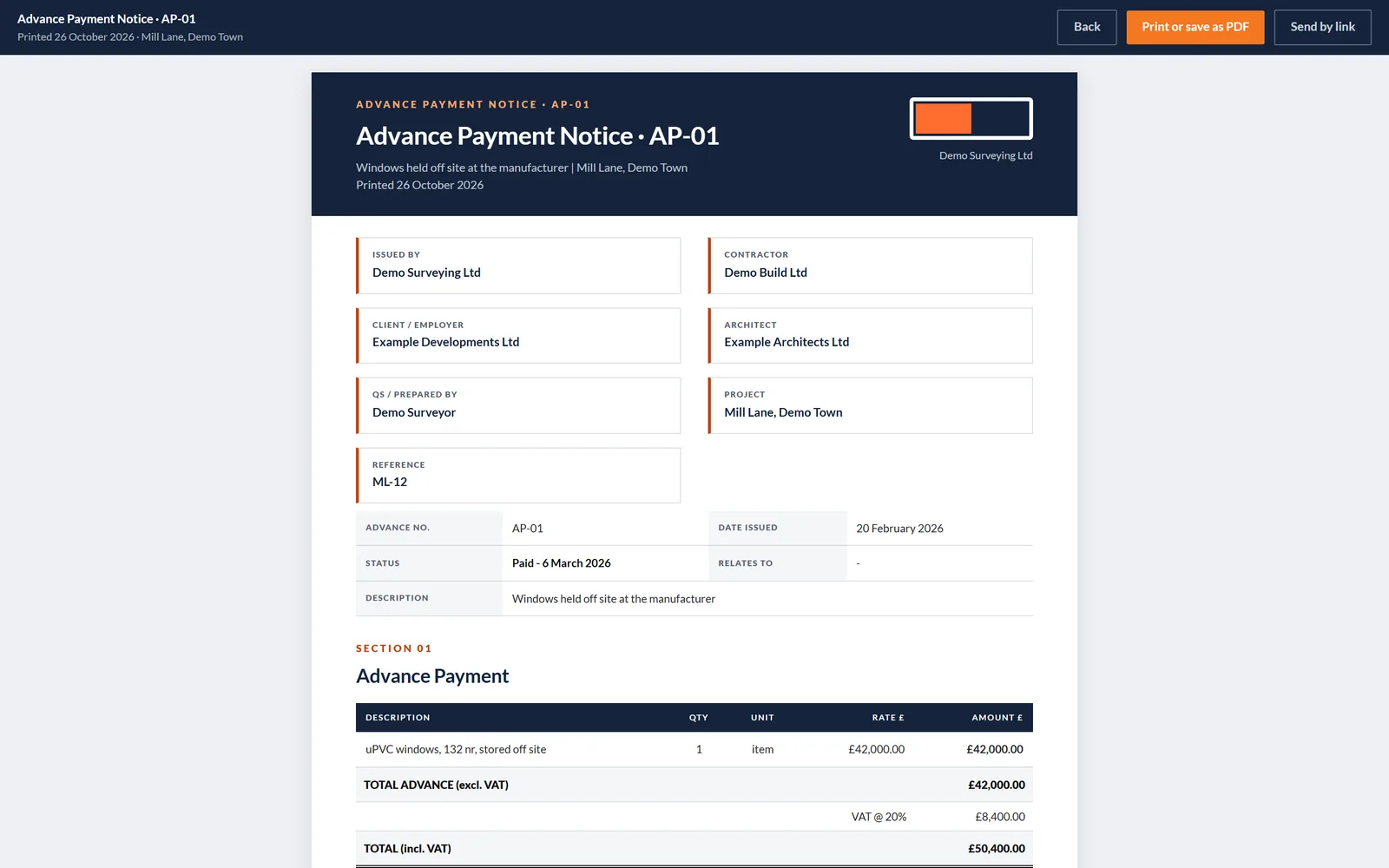
Yes. It prints on your letterhead with the description, the quantity and rate breakdown, the VAT and the total, ready to issue.

FIDIC splits it. A true advance payment is an interest-free loan under Sub-Clause 14.2, paid against an advance payment guarantee and repaid by deductions from later certificates, not tied to one bill line the way a UK materials-on-site advance is. Payment for Plant and Materials intended for the Works is certified separately under 14.5 once the Contract conditions are met. QScope runs both on the FIDIC calendar-day timetable, as published starting points to verify locally.

From the blog

The part nobody teaches you, written down

Three pieces from the same corner of a contract as this page, answered at length and without a sales pitch at the end.

All 174 pieces

Keep reading

The three parts this page leans on

Paid for once, recovered automatically

Materials delivered but not yet built in still have to be paid for, then recovered as the work is certified. Doing that from memory is how a contractor ends up paid twice for the same brick.

30 days free, no card.

Rather ask first? Write to help@qscope.co.uk and you will get a reply within one working day, Monday to Friday.