Defects
By the time the rectification period ends the team has moved on and the job is closed in everyone’s mind. A percentage of the contract sum is still sitting with the employer, and nothing prompts anybody.
30 days free, no card.
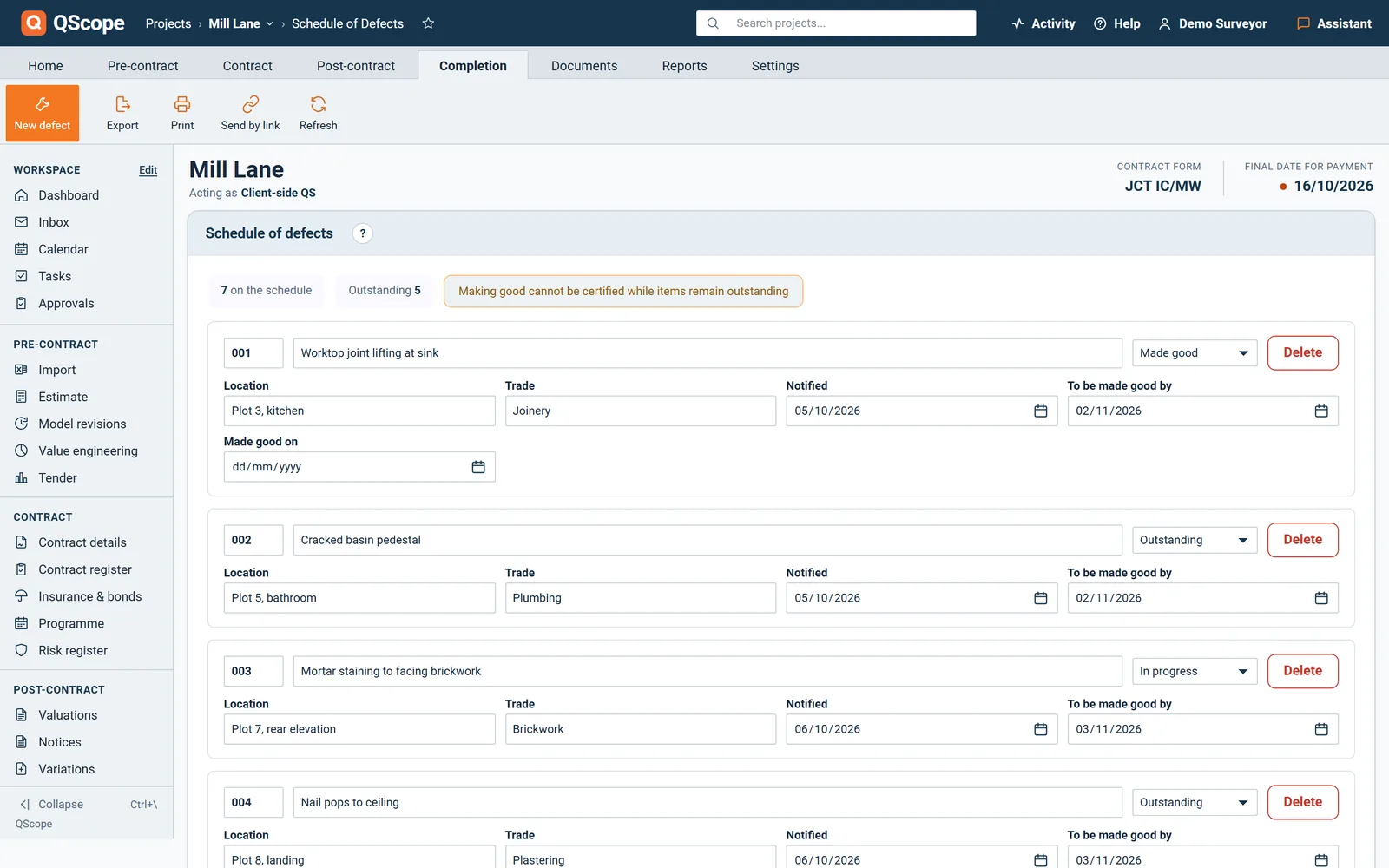
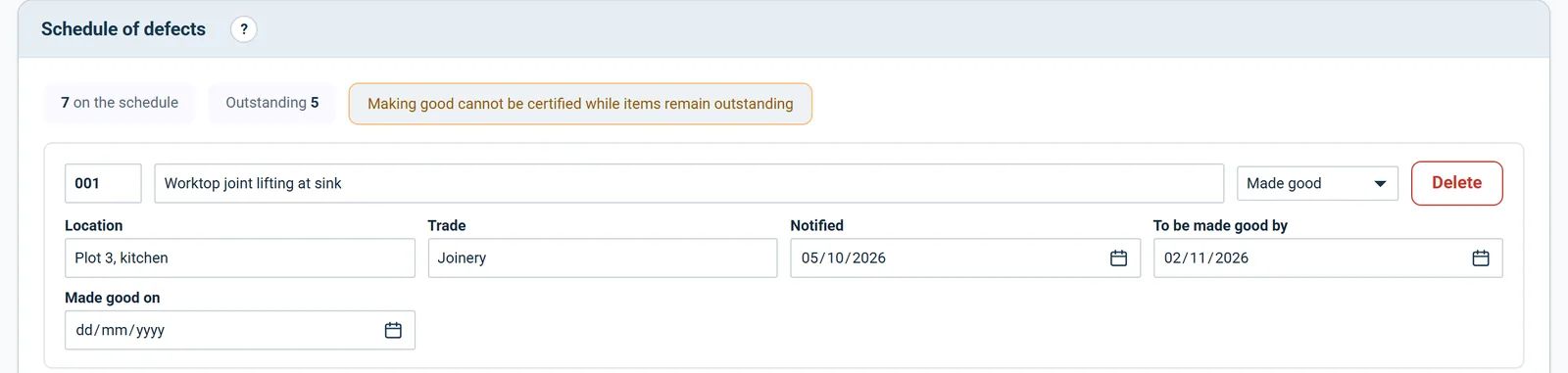
Four items remain outstanding, so making good cannot be certified. Certifying it now would release the final retention for work nobody has done.
Snagging at practical completion and the schedule of defects at the end of the rectification period are different documents with different consequences.
The second one is contractual: the certificate of making good depends on it, and the balance of the retention depends on that certificate. QScope keeps notified and made good as separate dates on every item, because those two dates are what show the period was operated properly if anyone examines it later.
Completion
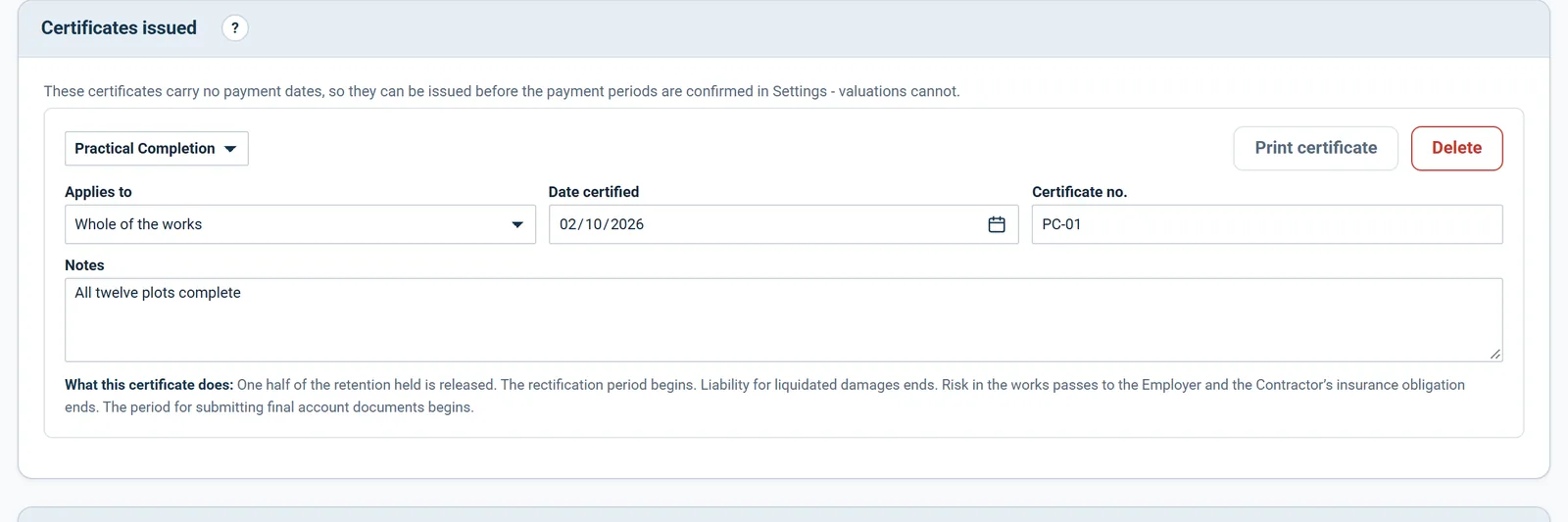
The certificate of making good releases the balance of the retention.
The remaining retention is released on this certificate. QScope will not let it be issued while the schedule still shows outstanding items.
Completion
The rectification period runs from practical completion, and the schedule has to be issued before that period ends.
The schedule is issued inside the rectification period, not after it. Issuing it late is a weaker position, not a stronger one.
Retention
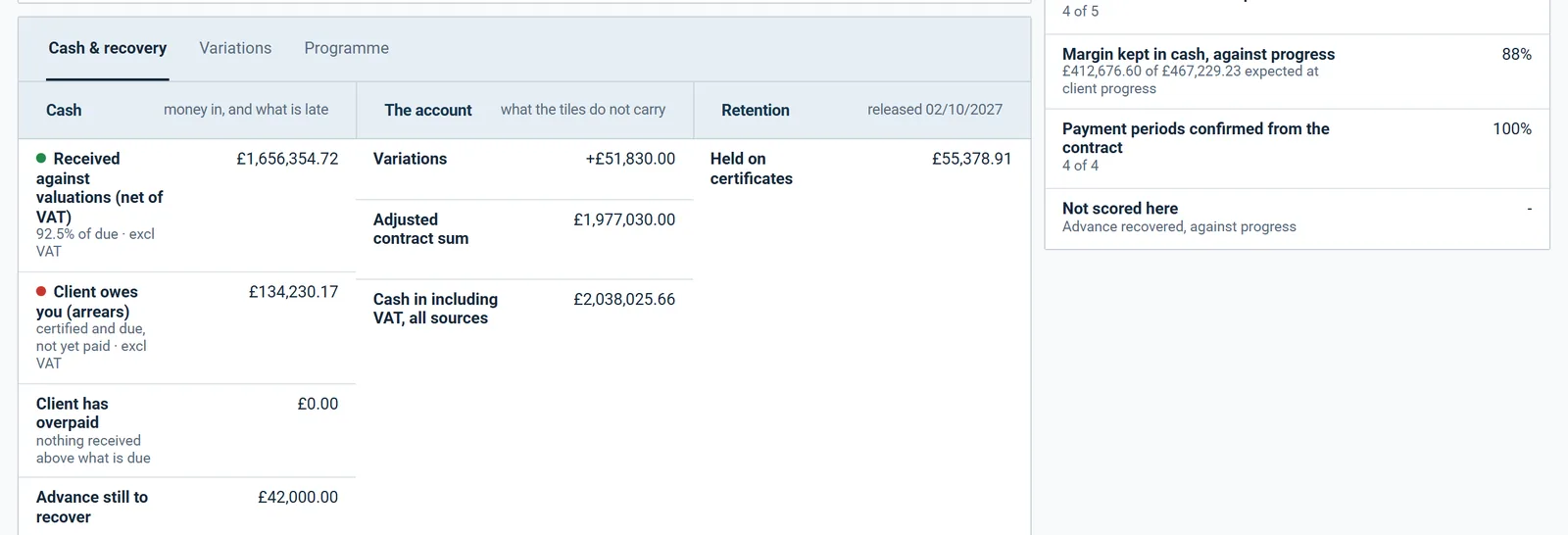
The schedule of defects exists because a percentage of the contract sum is still held, and the certificate of making good is what releases it.
The balance is released on the certificate of making good, which QScope blocks while the schedule shows outstanding items.
Project record
A defect argued two years after handover turns on evidence, and the evidence is the dated photograph nobody filed.
QScope keeps the photographs, the correspondence and the notices against the same project as the schedule, so the file is assembled as you go rather than reconstructed the week before an adjudication.
Defects
On a FIDIC contract the rectification period is the Defects Notification Period under Clause 11, and it runs from the Taking-Over Certificate rather than practical completion.
The Defects Notification Period runs from Taking-Over in calendar days. Four items remain, so the Performance Certificate cannot be issued and the second half of the retention stays held. The figures are a starting point to verify for the jurisdiction.
Who it is for
You are applying
You claim the time before damages runYou notice delay, name the relevant event and claim the time before the damages clock does the arguing for you.
Applying for paymentYou are certifying
You award the weeks and stop the clockYou assess the extension from the other chair, and the completion certificate you issue halves retention and stops the damages clock.
Certifying paymentYou are doing both
Your delay is your own money waitingYou run the programme and the money together, and a completion date that slips moves the whole payment tail with it.
Doing both yourselfYou are reporting
A late job is a loan running longYou track completion against the facility term, because a job that finishes late is a loan that runs longer than the model.
Recommending a drawdownThe client, the architect and the tenderer are not on this list. They are the people you let in on a link: they see the one document you sent them, answer it, and that answer is written into the record. No account, no licence, no charge, on every plan.
The questions this page raises most often, answered without a sales pitch at the end.
At the end of the rectification period, within the period the contract allows. Issuing it a year late is not a stronger position, it is a weaker one.
No. The certificate of making good states that the notified defects have been made good. Liability for defects that were not apparent continues for the limitation period.
Yes. Export to CSV, or print the schedule as a formal document with the trade against each item.
Record it as disputed rather than leaving it outstanding. It still blocks the certificate, which is correct, and the status makes clear that the block is a disagreement rather than a delay.
The rectification period is the Defects Notification Period under Clause 11, running from the Taking-Over Certificate, and the certificate of making good is the Performance Certificate under Sub-Clause 11.9. QScope blocks that certificate while items remain outstanding, exactly as under a UK form, and counts the period in calendar days.
From the blog
Three pieces from the same corner of a contract as this page, answered at length and without a sales pitch at the end.
A defect is work that does not match the contract, and half the items on an angry snag list fail that test: they match the contract and not the client’s imagination. How to sort a defects schedule into its four real categories, and answer it without a war.
Read nowThe dividing line is simpler than the clause lists make it look: delay from the client’s side of the fence gives time, delay from yours does not, and neutral events give whatever the contract chose to give. Where weather really sits.
Read nowAlmost certainly yes: the defects period ending did not end your responsibility, it ended a retention mechanism. How long liability really runs, six years on a signed contract, twelve on a deed, and how to respond to the call.
Read nowKeep reading
By the time the rectification period ends the team has moved on and the job is closed in everyone’s mind. A percentage of the contract sum is still sitting with the employer, and nothing prompts anybody.
30 days free, no card.
Rather ask first? Write to help@qscope.co.uk and you will get a reply within one working day, Monday to Friday.