QScope

Cash flow

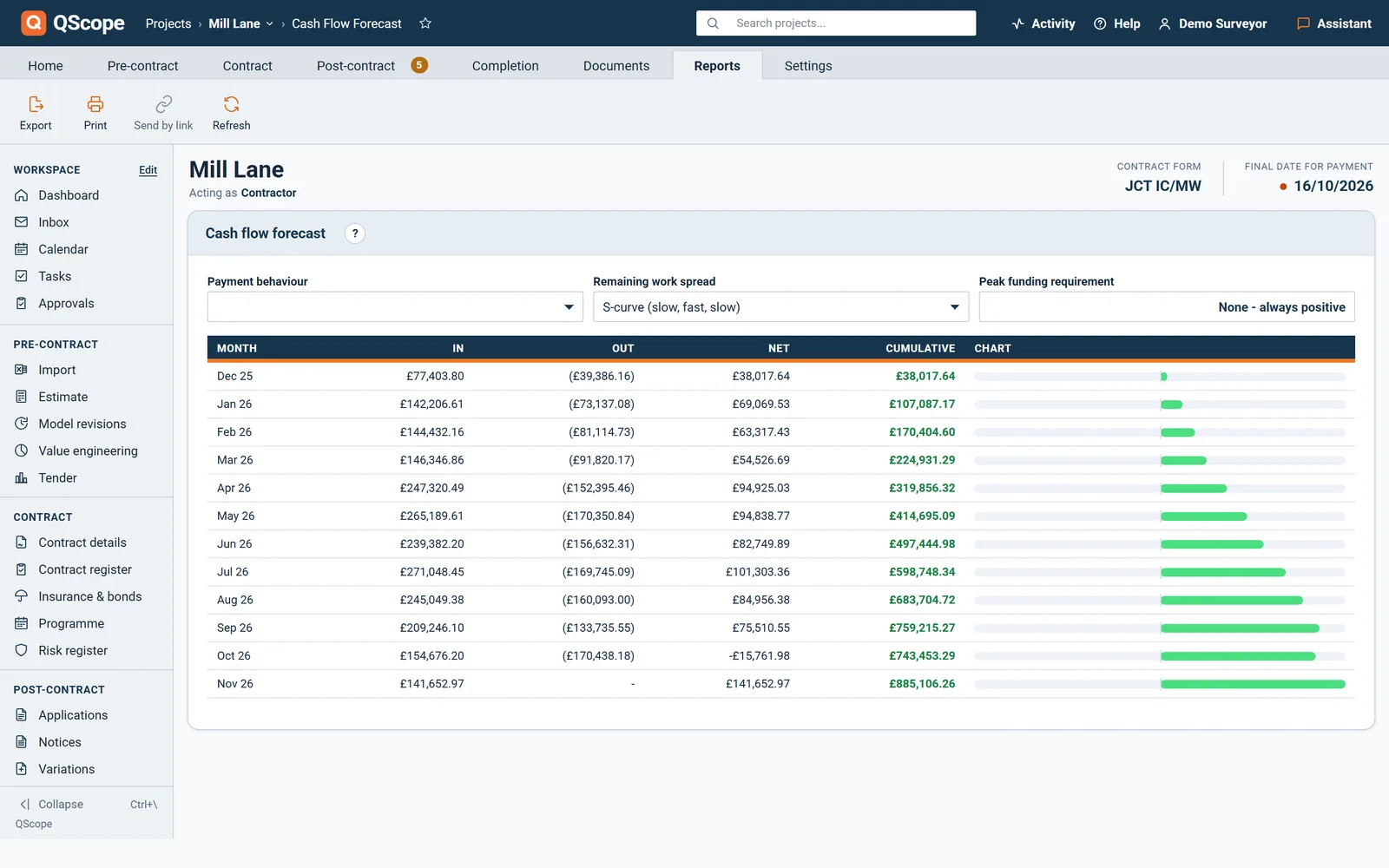
The number you actually need is the peak

Projects do not fail because they were unprofitable. They fail because the money went out before it came in, and nobody had modelled the gap.

  • Payment behaviour from on time to thirty days late
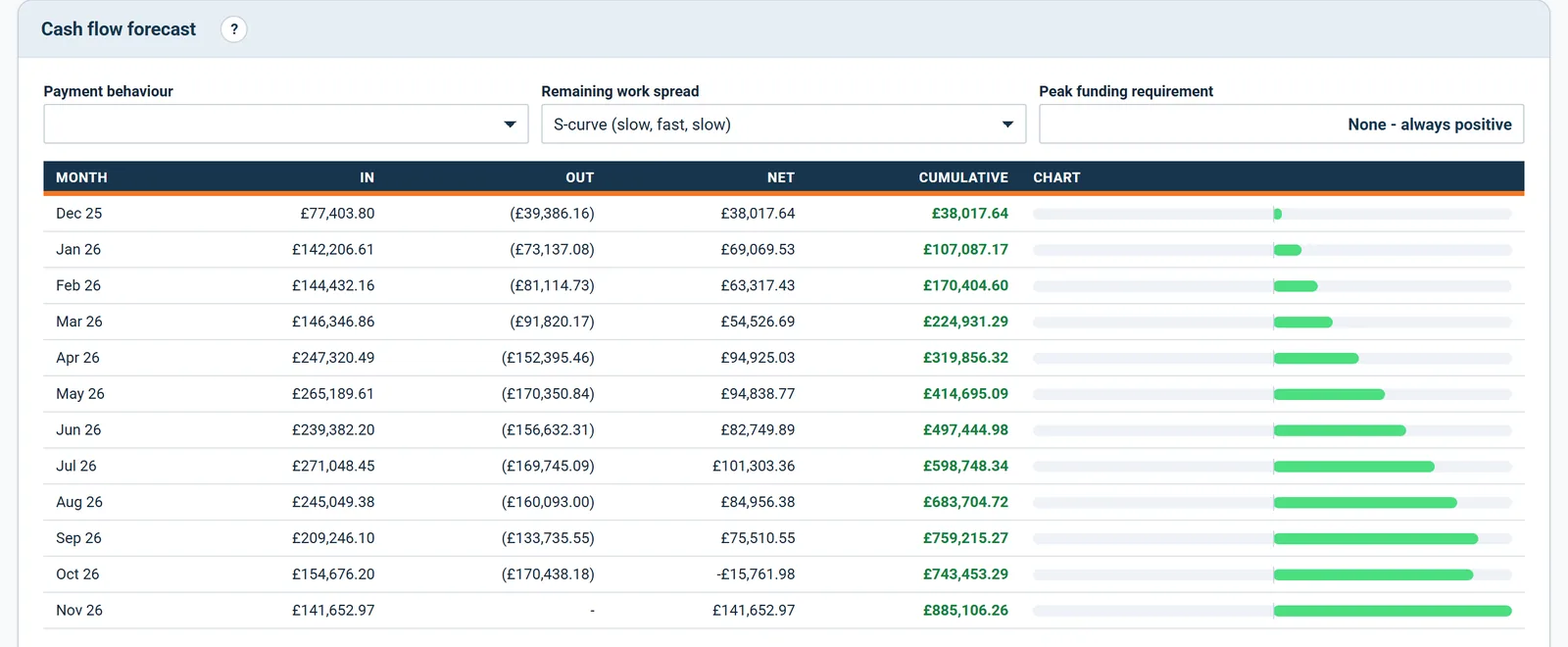
  • Monthly view with cumulative position and a visual bar
  • Prints for a funder or a board pack

30 days free, no card.

Cash flow
Monthly position
Receipts, Nov£96,200
Payments to subcontractors, Nov(£111,300)
Net for the month(£15,100)
Cumulative(£186,400)

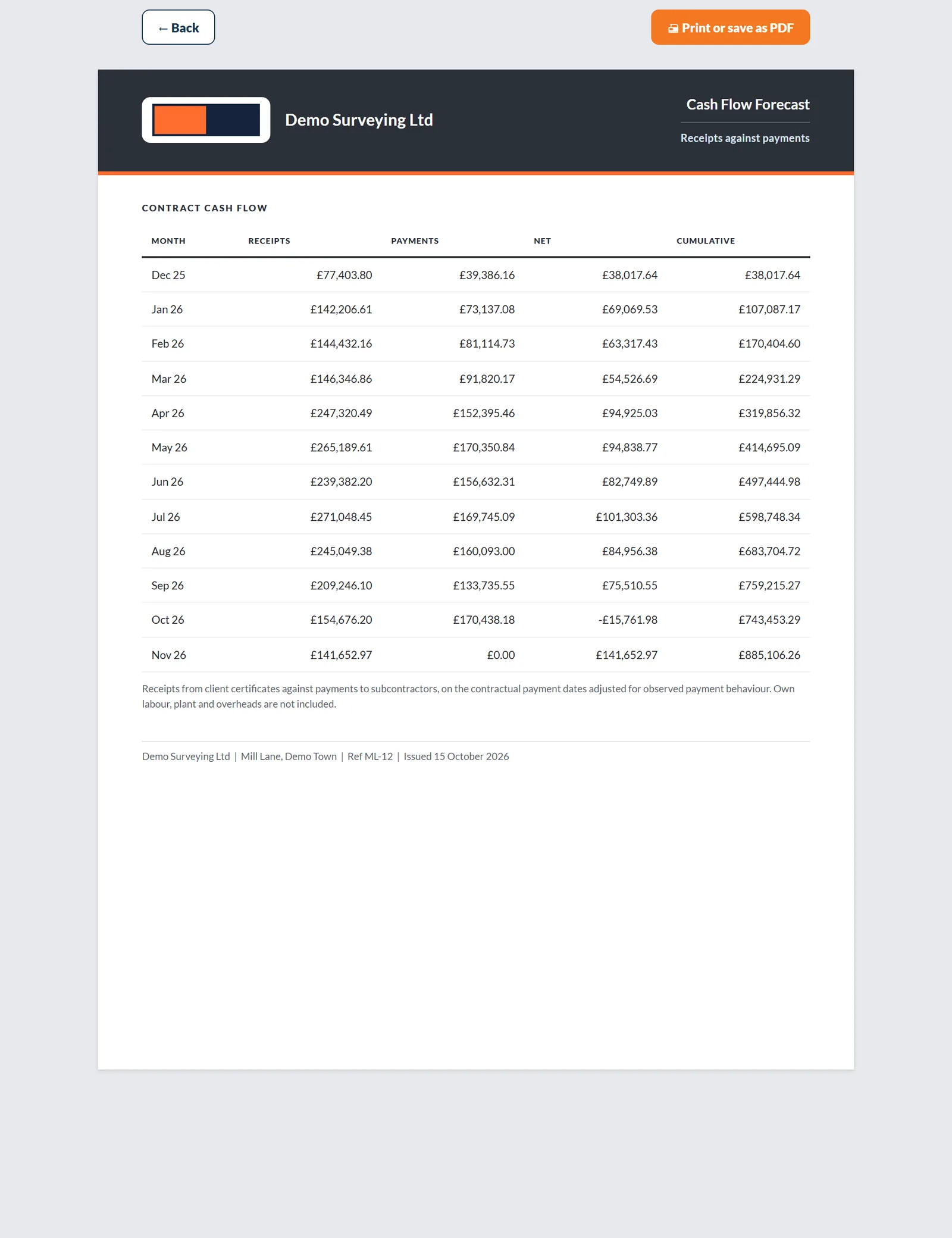
This is the cash flow of the contract. Your own labour, plant and overheads are not in it, because the program does not hold them, and pretending otherwise would be worse than saying so.

On time is a best case, not an expectation

Late payment is common enough that a forecast built on contractual dates is optimistic by default.

QScope lets you model the behaviour you actually see, so the peak reflects the world rather than the contract. The tail matters as much as the peak. Retention and an unagreed final account keep the position negative long after practical completion, and a forecast that goes positive at handover is wrong by exactly that amount.

Cash flow

Built from the dates that already exist

Every certificate already carries a valuation date, a due date and a final date for payment.

  • Receipts from client certificates on the contractual payment dates
  • Payments to subcontractors on their own cycle
  • Remaining valuations projected on an S-curve or evenly
Cash flow
Forecast
Peak funding
£186,400
Occurs
Nov 26
Cycles left
5
The peak is the deepest point of the cumulative line. It is the sum that has to be funded, and it is usually still ahead of you.

Remaining cycles are projected from the valuation schedule, with the uncertified balance spread on an S-curve, because that is how construction actually runs: slow, fast, slow. An even spread flatters the early months and hides the peak.

Client Valuations

Receipts are your own certificates, not an estimate

The money coming in is not a guess.

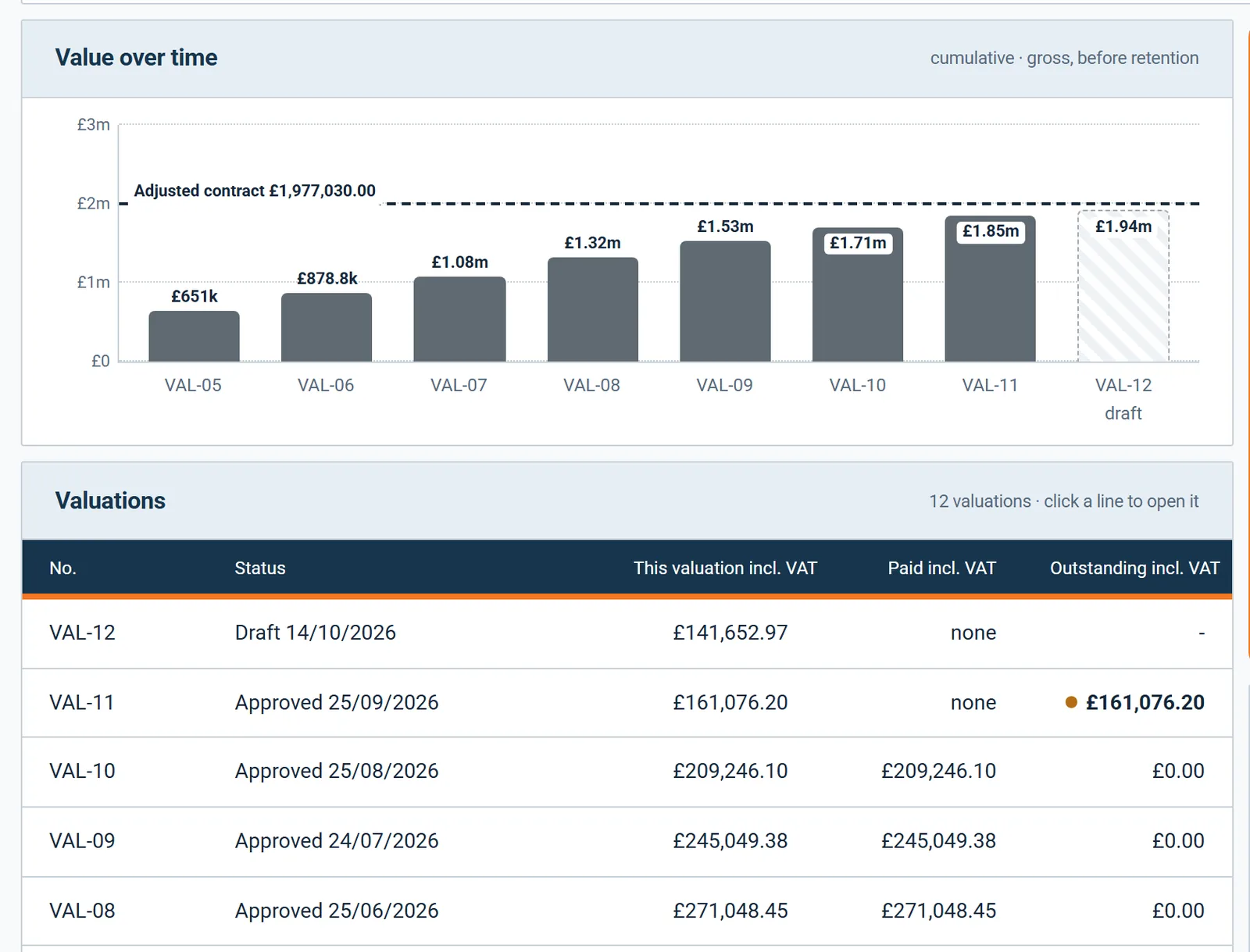
  • Receipts taken from the net due on each issued certificate
  • Retention withheld on the certificate flows straight into the forecast
  • Remaining cycles projected from the same valuation schedule
Client Valuations
Certificate feeding the forecast
This period, exc VAT£24,180.00
Less retention at 5%(£1,209.00)
Due this certificate, exc VAT£14,031.00
Lands on final date for payment29 Aug 2026

The receipt in the forecast is the net figure after retention, on the date the money actually arrives, not the day the valuation was signed.

See it running before you sign up

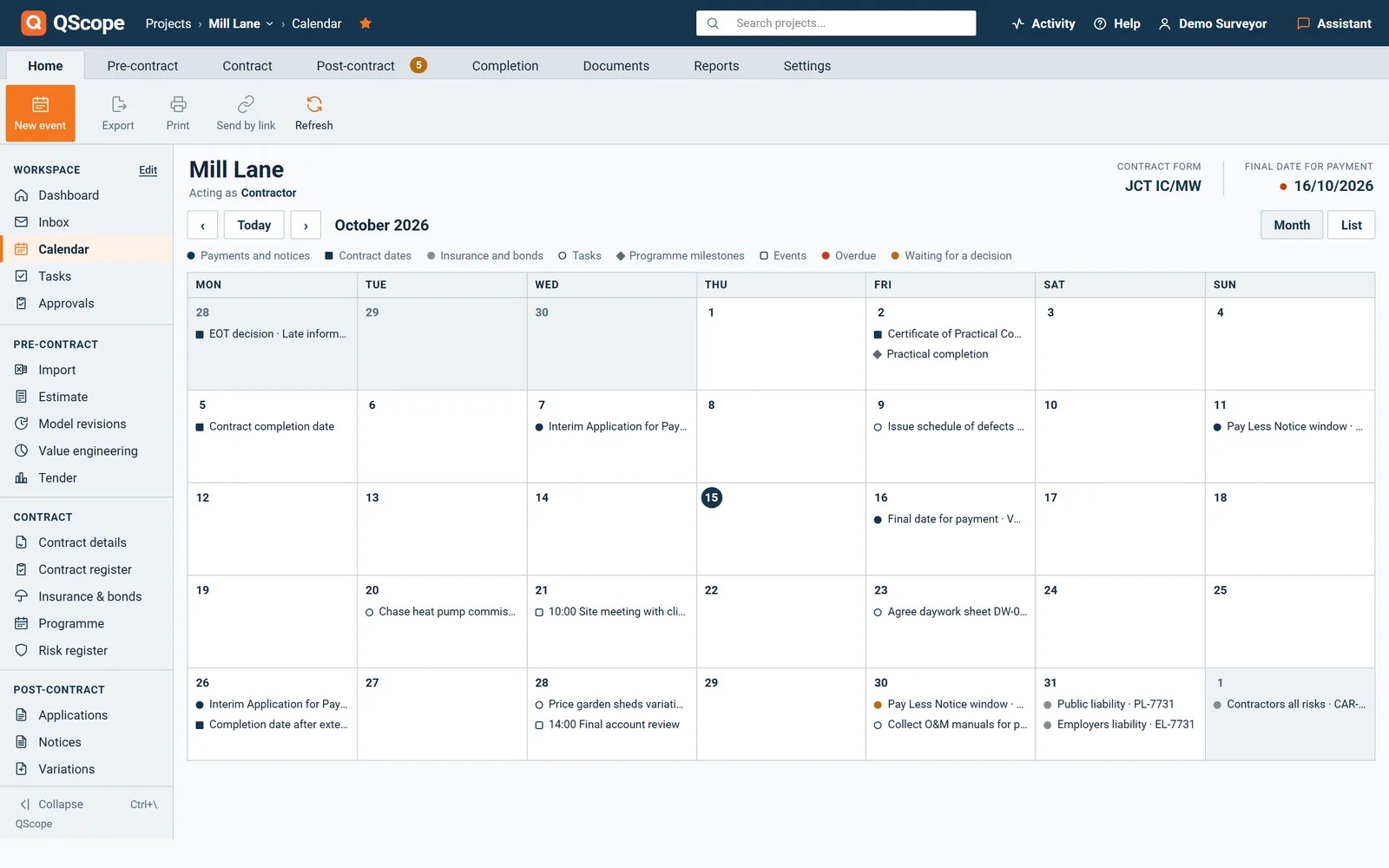
Statutory payment dates

Money lands on the final date for payment, not the valuation date

A forecast that pays on the valuation date is weeks early and wrong in your favour.

  • Final date for payment counted from the due date per contract form
  • Weekends and England and Wales bank holidays excluded from the count
  • Late payment behaviour applied on top where you expect it
Statutory payment dates
Dates behind the receipt
Due date15 Aug 2026
Last date for payment notice20 Aug 2026
Last date for a pay-less notice24 Aug 2026
Final date for payment29 Aug 2026

The receipt for this certificate falls in the forecast on 29 Aug 2026, fourteen days after the due date, not on the valuation date two weeks earlier.

Cash flow

The payment cycle that drives the peak is not the same everywhere

The gap between doing the work and being paid for it is what the peak measures, and that gap is set by the contract form and the jurisdiction.

  • FIDIC certificate within 28 days, Employer payment within 56 days of the Statement
  • Calendar days, with no UK-style payment notice or pay-less notice under FIDIC
  • Currency set for the market, printed on your own letterhead
Cash flow
FIDIC receipt, calendar days
Statement received by the Engineer03 Aug 2026
Interim Payment Certificate, within 28 days31 Aug 2026
Employer pays, within 56 days28 Sep 2026
Receipt lands in the forecast£512,000

The 56 day period runs from the Statement in calendar days, so the receipt sits nearly two months out. On a UK contract the same certificate would land a fortnight after the due date. The defaults are editable for the Particular Conditions, and the figures are a starting point to verify locally.

Reports

The forecast prints for a funder or a board

The peak funding requirement is only useful once it leaves the screen.

  • Peak funding and the month it occurs stated as figures
  • Cumulative position printed month by month
  • On your practice letterhead, never QScope branding
Reports
Cash flow for the board
Peak funding
£186,400
Occurs
Nov 26
Cycles left
5
Sep 26 · actual(£142,900)
Oct 26 · actual(£171,300)
Nov 26 · forecast(£186,400)
Dec 26 · forecast(£164,100)

QScope prints the forecast alongside the reports a QS already sends, so the cash position sits next to the cost report and the payment schedule rather than in a spreadsheet nobody else can open.

Who it is for

One record, four reports that must agree

You are applying

You report cost against money secured

You report cost against the sum you have actually secured, and the difference between the two is the conversation with your own board.

Applying for payment
the same measurement

You are certifying

You report on figures you certified

You report to the client on a job you certify, and the report has to reconcile with the certificates you signed.

Certifying payment

You are doing both

Your record is the only report there is

You are the report: what you have applied for, what has been certified and what is still to fund, pulled from your own record.

Doing both yourself

You are reporting

You turn the record into a drawdown

You turn the project record into a drawdown recommendation, and the figures have to reconcile before the lender releases a pound.

Recommending a drawdown

The client, the architect and the tenderer are not on this list. They are the people you let in on a link: they see the one document you sent them, answer it, and that answer is written into the record. No account, no licence, no charge, on every plan.

FAQs

The questions this page raises most often, answered without a sales pitch at the end.

No, and it does not claim to be. It is the cash flow of one contract: money in from client certificates against money out to subcontractors. Own labour, plant and overheads sit in your accounts, not here.

From the valuation schedule in project settings, with the uncertified balance spread across the remaining cycles. You choose an S-curve or an even spread.

Yes. Retention is withheld on the forecast certificates at the correct rate, and released on the dates the certificates and the rectification period produce.

It prints as a document. Whether it suits a funder depends on what they need, and most will want your own cost base alongside it.

Yes. It places receipts on the FIDIC payment period, 56 calendar days from the Statement on the 1999 default, and carries the currency for the market. The 28 and 56 day periods are editable for the Particular Conditions, and country figures are starting points to verify locally.

From the blog

The part nobody teaches you, written down

Three pieces from the same corner of a contract as this page, answered at length and without a sales pitch at the end.

All 174 pieces

Keep reading

The three parts this page leans on

The number you actually need is the peak

Projects do not fail because they were unprofitable. They fail because the money went out before it came in, and nobody had modelled the gap.

30 days free, no card.

Rather ask first? Write to help@qscope.co.uk and you will get a reply within one working day, Monday to Friday.