QScope

Cost and value

One cut-off, or it is not a reconciliation

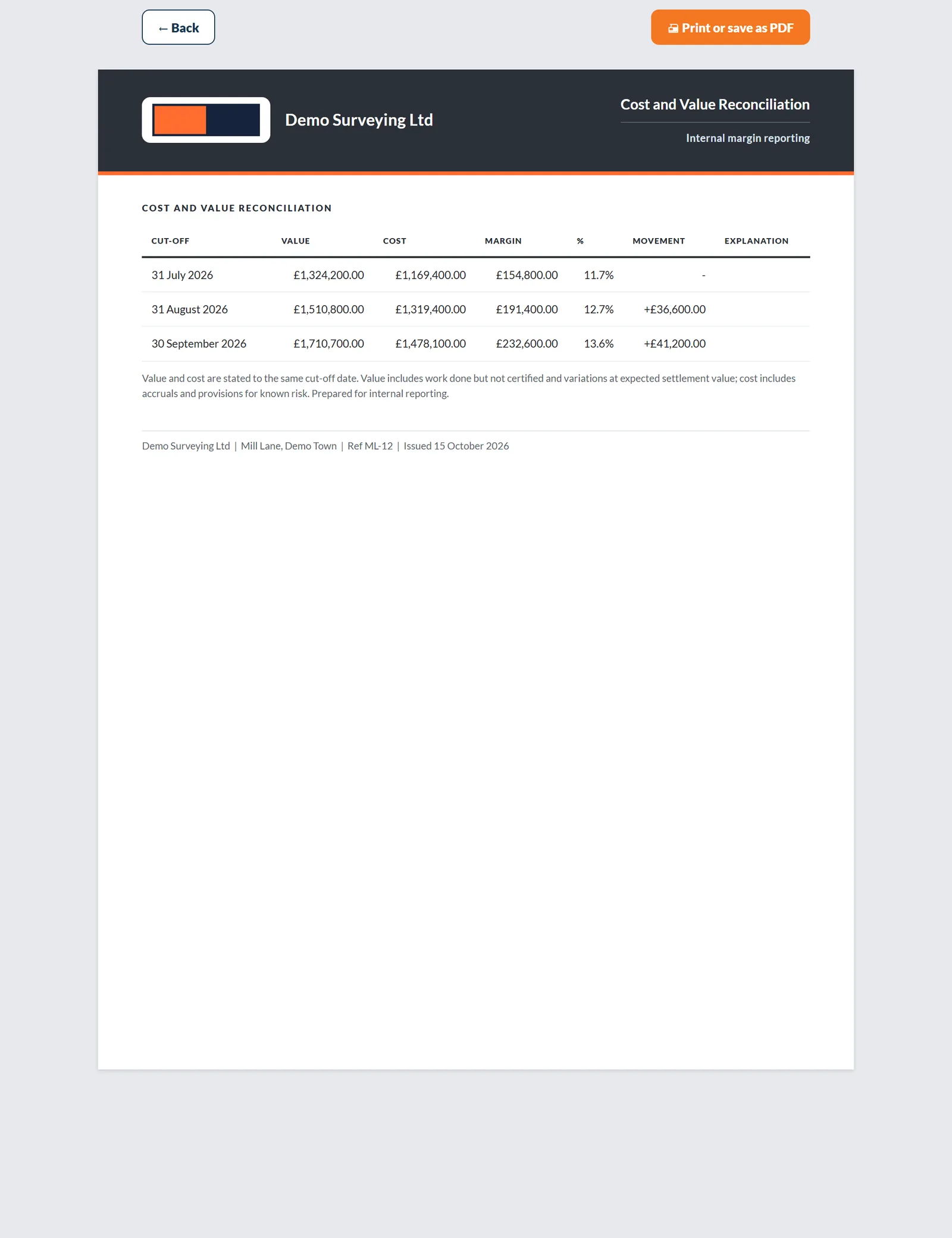
Value from the last certificate and cost from the ledger at month end are not two sides of the same project. They are two different projects being compared with each other.

  • Variations move from settlement value to agreed value
  • Provisional sums adjusted against what the work actually cost
  • Retention release shown explicitly on the value side

30 days free, no card.

Final account
Statement to settlement
Original contract sum£1,352,000
Variations, approved+£46,000
Provisional sums adjusted(£12,000)
Adjusted contract sum£1,386,000
Less certified to date, gross(£1,196,000)
Add retention release+£29,900
Final balance due, excl VAT£219,900

Variations carried at settlement value in the CVR become agreed figures in the final account, so the margin you reported month by month is tested against the adjusted contract sum rather than quietly abandoned.

Where the margin is finally proven

Every period of a CVR is a forecast of the same thing: the margin at the end.

The final account is where the forecast is settled and the estimating stops. Variations carried at settlement value in the CVR become agreed figures in the final account, so the margin you reported month by month is tested against the adjusted contract sum rather than quietly abandoned.

Cost and value

The date governs both sides

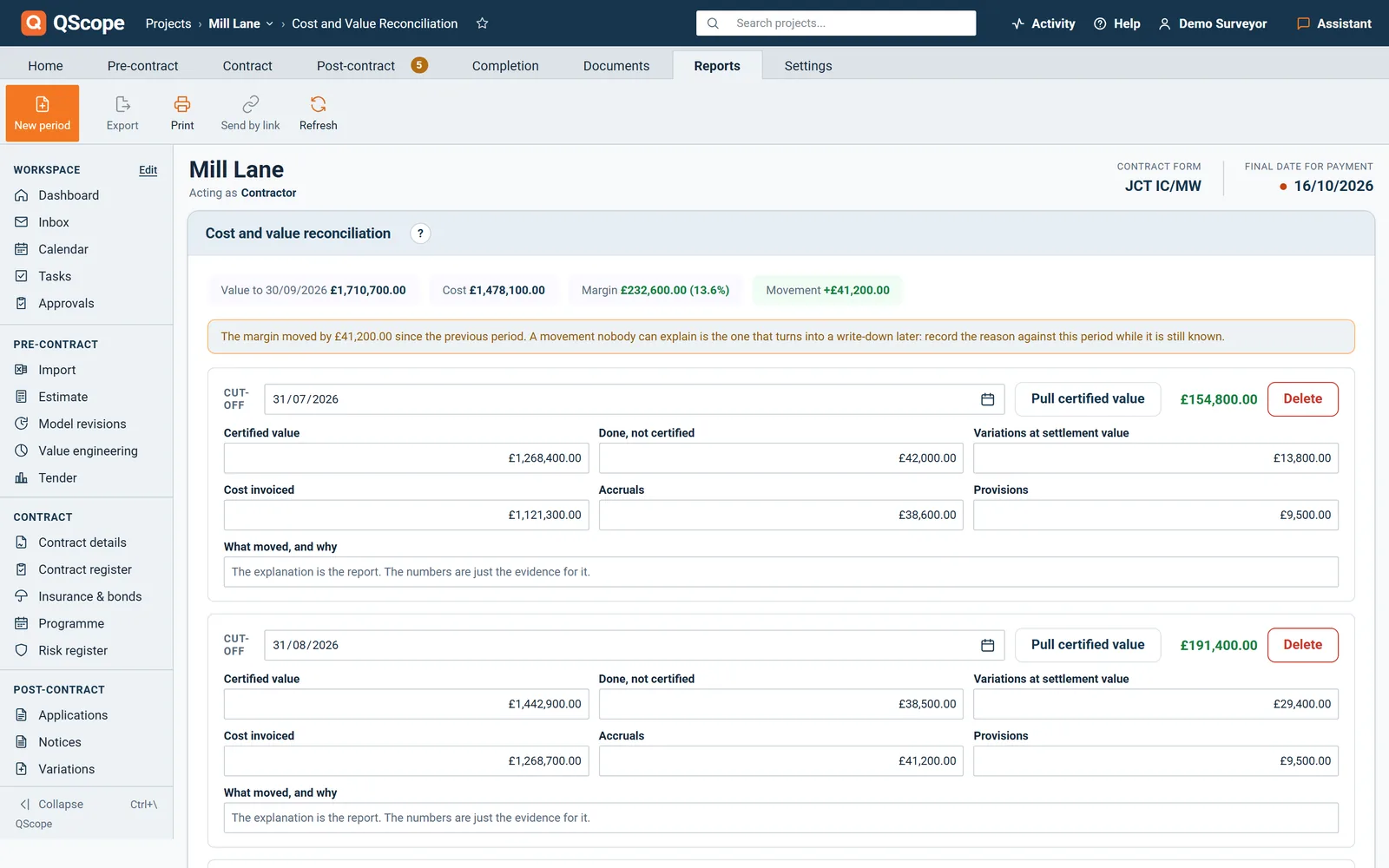
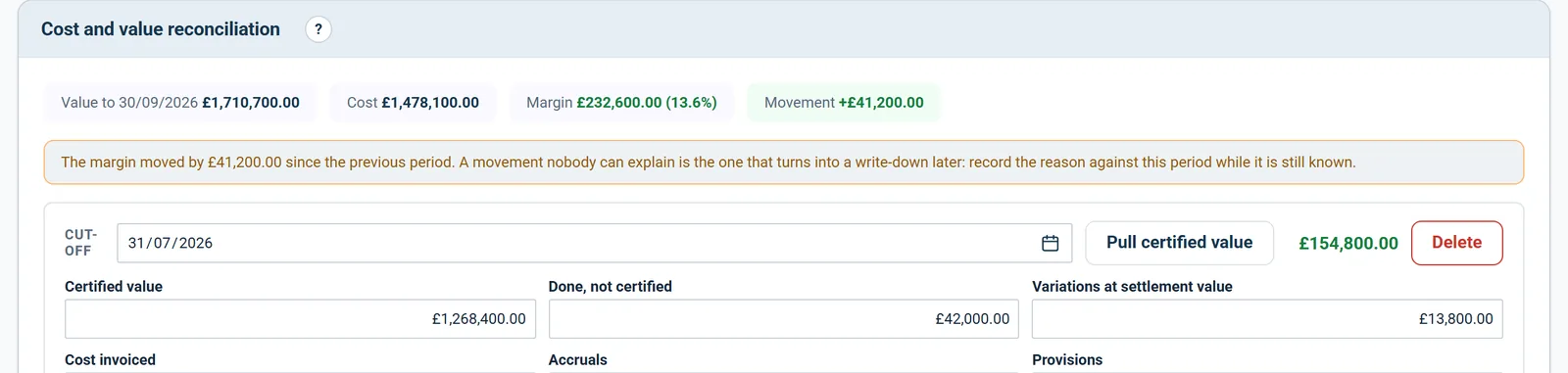
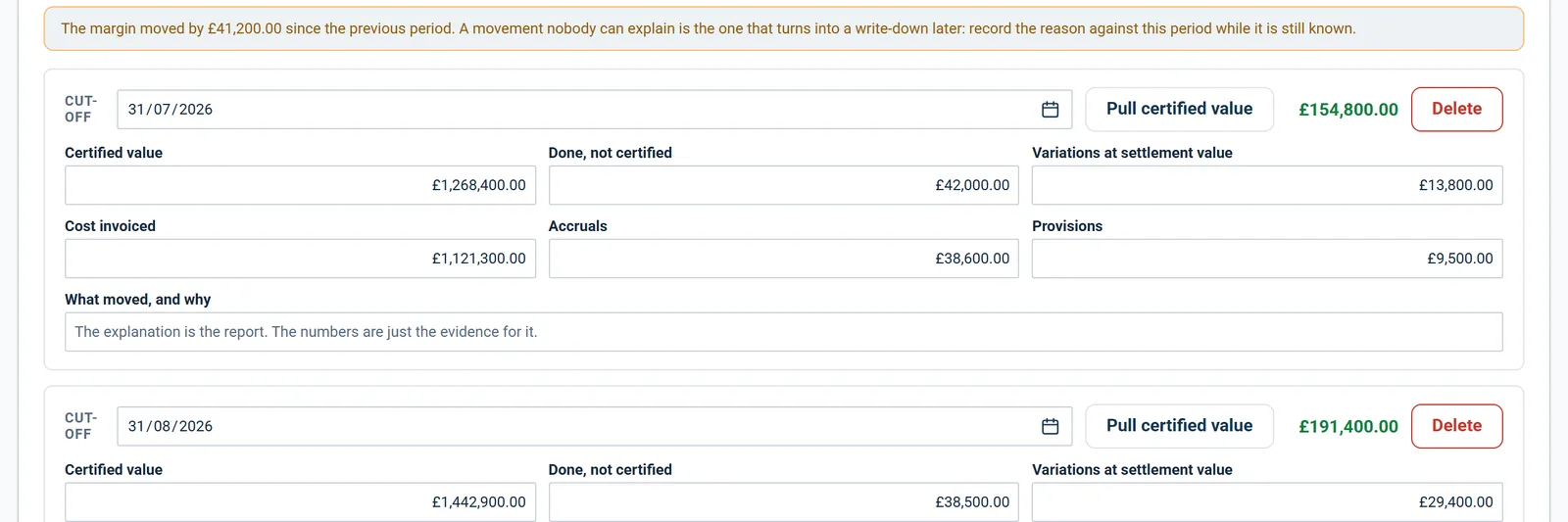
A CVR is a matter of judgement dressed as arithmetic, and the judgement that matters most is the cut-off.

  • One cut-off date per period, applied to value and cost
  • Certified value pulled from the certificates already issued
  • Work done but not certified and variations at settlement value, entered separately
Cost and value
Period to 30 Nov 26
Value
£1,284,000
Cost
£1,171,000
Margin
8.8%
Certified value£1,196,000
Done, not certified£42,000
Variations at settlement value£46,000
Value to the cut-off£1,284,000

Variations are carried at what you expect to settle at, not at what was applied for. The difference between those two is where optimism enters a margin.

Cost and value

Accruals and provisions, prompted

Cost incurred but not yet invoiced has to be accrued, or the cost side is understated and every job looks profitable until the post arrives.

  • Cost invoiced, accruals and provisions entered separately
  • Warning where accruals or provisions are nil
  • Movement against the previous period, with a prompt to explain it
Cost and value
Movement
Margin, period to 31 Oct£121,400
Margin, period to 30 Nov£113,000
Movement(£8,400)
Explanation recordedYes

A movement nobody can explain is the one that turns into a write-down later. The explanation is the report; the numbers are the evidence for it.

See it running before you sign up

Reports

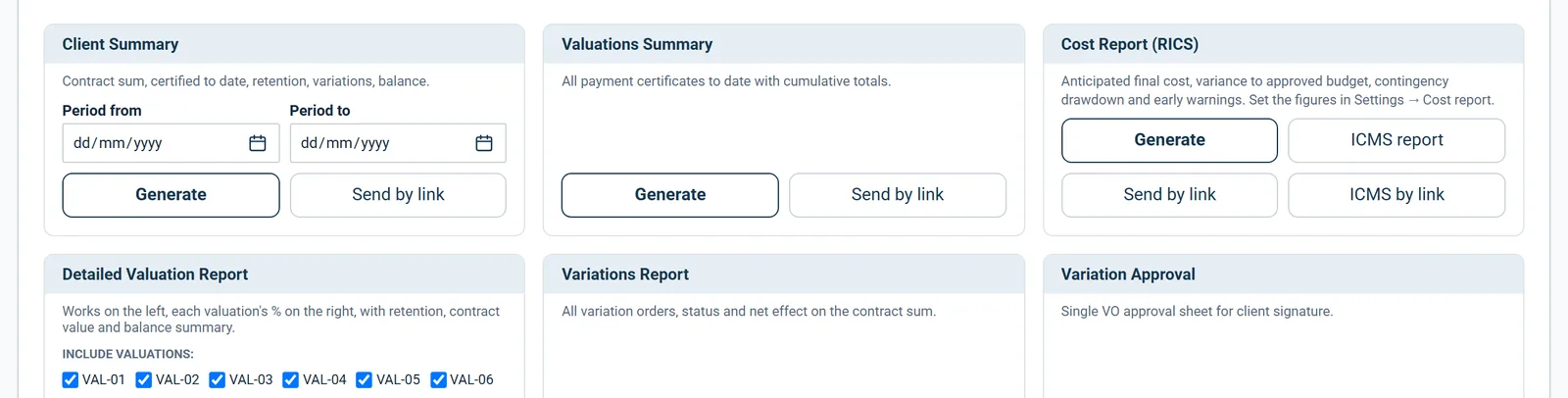
The client sees a cost report, not your margin

A CVR is an internal document.

  • Margin and cost stay internal, hidden from client guest links
  • Anticipated final cost against approved budget for the client
  • Variance stated as a figure, not signalled only by colour
Reports
Cost report to client
Approved budget
£1,400,000
Anticipated
£1,388,000
Variance
+£12,000
Certified to date£1,196,000
Committed, not certified£168,000
Risk allowance carried£24,000
Anticipated final cost£1,388,000

The same figures drive a cost report that faces the client: anticipated final cost against budget, with no reference to cost or margin. One set of numbers, two audiences, kept apart on purpose.

Risk register

The provisions in a CVR come from somewhere

Carrying no provisions assumes nothing will go wrong, which is why QScope warns on a nil period.

  • Each risk carries a cost, a probability and an owner
  • Allowance calculated as probability times cost, per risk and in total
  • Total allowance feeds the CVR provision
Risk register
Commercial risk and provision
RiskProb.Allowance
Ground conditions below slab30 %£11,400
Late structural steel delivery45 %£6,300
Client changes to M&E layout20 %£6,300
Asbestos in the annexe10 %Closed
Total allowance into the CVR£24,000

The risk register quantifies each commercial risk as probability times cost, and the total feeds the provision in the CVR, so the figure protecting your margin can be defended line by line.
Who it is for

One record, four reports that must agree

You are applying

You report cost against money secured

You report cost against the sum you have actually secured, and the difference between the two is the conversation with your own board.

Applying for payment
the same measurement

You are certifying

You report on figures you certified

You report to the client on a job you certify, and the report has to reconcile with the certificates you signed.

Certifying payment

You are doing both

Your record is the only report there is

You are the report: what you have applied for, what has been certified and what is still to fund, pulled from your own record.

Doing both yourself

You are reporting

You turn the record into a drawdown

You turn the project record into a drawdown recommendation, and the figures have to reconcile before the lender releases a pound.

Recommending a drawdown

The client, the architect and the tenderer are not on this list. They are the people you let in on a link: they see the one document you sent them, answer it, and that answer is written into the record. No account, no licence, no charge, on every plan.

FAQs

The questions this page raises most often, answered without a sales pitch at the end.

No. The cost side is entered by hand and stays that way. The program has no access to your accounts, and pretending it did would be the worst possible choice in a report about margin.

Contractors and subcontractors reporting internally. A client-side quantity surveyor reports the anticipated final cost instead, which is a different document with a different audience.

One per valuation cycle is usual, so the cut-off lines up with something that already exists rather than a date chosen for the report.

Because carrying none assumes nothing will go wrong, and that assumption is almost never deliberate. If it is deliberate, the warning costs you nothing.

Yes. A CVR is largely the same everywhere: value against cost to one cut-off. QScope carries the currency for the market, and the tax on the final balance varies by jurisdiction, VAT, GST or SST, which sits outside the margin rather than in it. Rates are starting points to verify locally.

From the blog

The part nobody teaches you, written down

Three pieces from the same corner of a contract as this page, answered at length and without a sales pitch at the end.

All 174 pieces

Keep reading

The three parts this page leans on

One cut-off, or it is not a reconciliation

Value from the last certificate and cost from the ledger at month end are not two sides of the same project. They are two different projects being compared with each other.

30 days free, no card.

Rather ask first? Write to help@qscope.co.uk and you will get a reply within one working day, Monday to Friday.