QScope

Completion

The certificates that actually move money

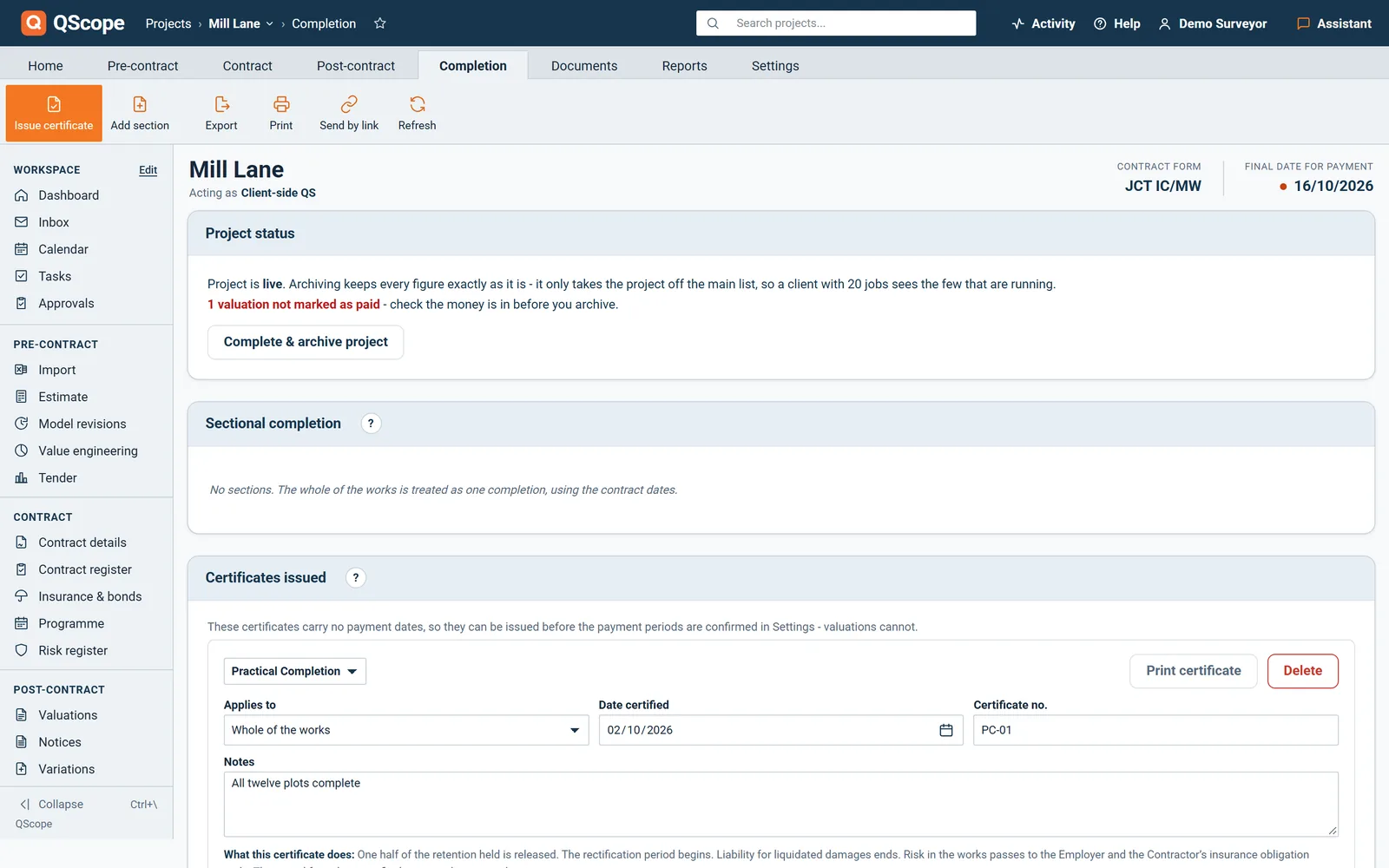
Practical completion is not a tidy site. It is a certificate, and on the date it carries, five separate things change at once. A program that prints the certificate and leaves the figures alone has done the easy half.

  • Sections with their own value, dates and damages rate
  • Retention released against the section, at that section’s practical completion
  • Partial possession reduces damages proportionately from the date of possession

30 days free, no card.
Completion
Sectional retention
Section A · PC 3 Mar 26£400,000
Section B · PC 9 Sep 26£600,000
Retention held on all works£50,000
Released at section PCs(£25,000)
Held after both sections£25,000

Half the retention attributable to each section is released at that section’s own practical completion, not at the end of the contract.
Sections and partial possession, handled separately

Where the contract divides the works into sections, each has its own completion date, its own damages rate and its own retention release.

A section handed over in March should not be waiting on a contract that finishes in November, and in most systems it is. Partial possession works the same way. Give the part a value and QScope releases retention against it as if it had reached practical completion, and reduces the damages rate in the same proportion, from the date of possession rather than retrospectively.

Completion

Issuing the certificate changes the arithmetic

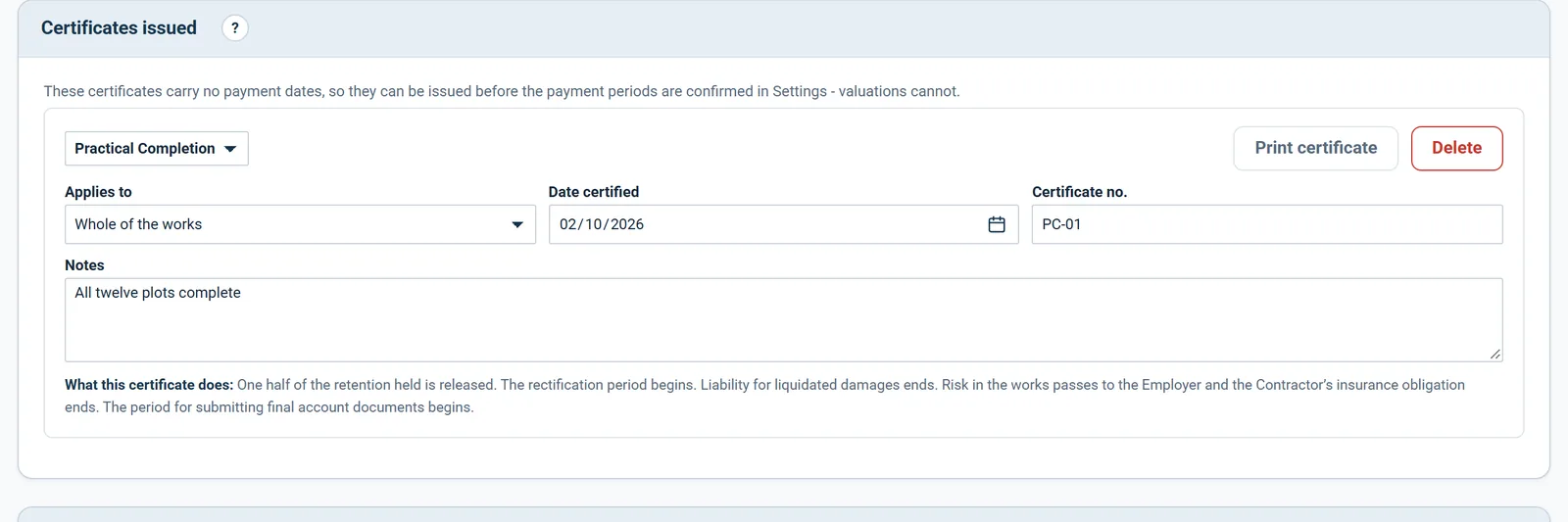
Enter the date on the certificate and the retention halves from that valuation, the rectification period starts, and liability for liquidated damages ends.

  • Practical completion, partial possession, non-completion, making good and the final certificate
  • Each certificate prints as a formal document with the clause reference and its consequences
  • The certificate governs over the settings field, with a warning if the two disagree
Completion
Certificate of practical completion
Certified
7 Sep 26
Retention now
2.5%
Released
£12,500
Rate before certificate5.0%
Rate after certificate2.5%
Rectification period12 months
Balance released7 Sep 2027

Half the retention held was released on the certified date. The balance follows the certificate of making good.

Completion

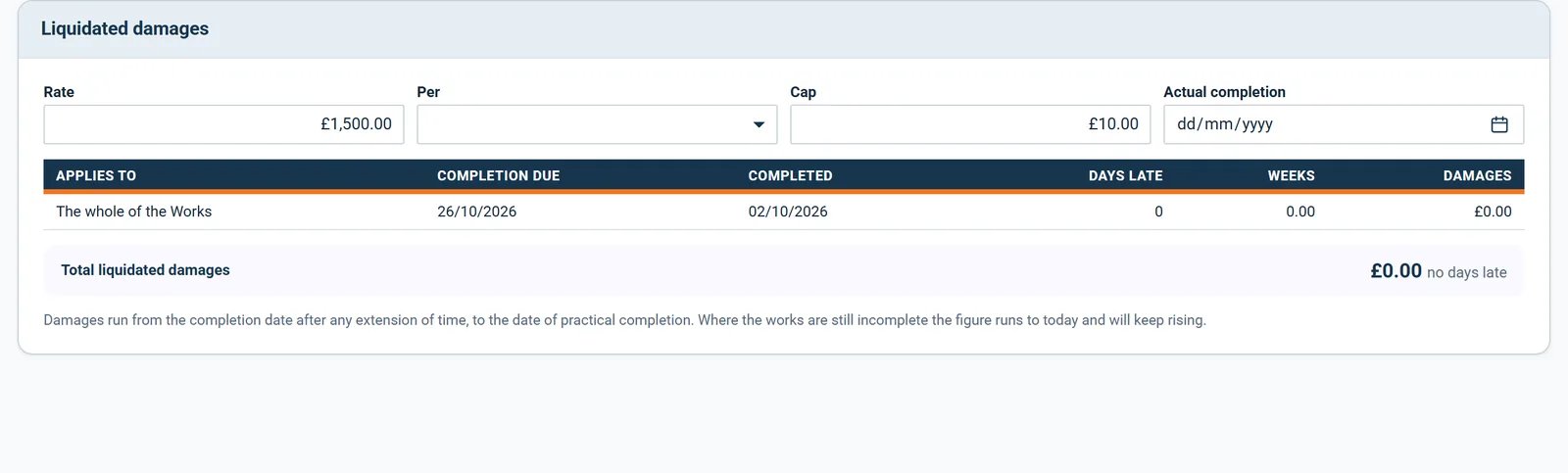
Damages that survive being challenged

The calculation takes a minute.

  • Damages run from the revised completion date, not the original
  • Cap applied where the contract states one
  • Red warning where no certificate of non-completion has been issued
Completion
Liquidated damages
Completion date after extension12 Oct 2026
Practical completion9 Nov 2026
Weeks late4.00
Rate per week£2,500
Damages£10,000

No certificate of non-completion is on the register. Under a JCT form the deduction cannot be made until it is issued and the employer has given notice.

See it running before you sign up

Retention

The certificate hands the retention to the retention module

The moment practical completion is certified the held retention halves, and QScope carries the new figure straight onto the retention notice the client receives.

  • Rate halved from the certified date, not from a settings field
  • Release notice printed for the client on your letterhead
  • Balance held to the end of the rectification period
Retention
Position after PC-04
Rate now
2.5%
Held
£12,500
Release
7 Sep 27
Retention before certificate£25,000.00
Released at practical completion(£12,500.00)
Held to end of rectification£12,500.00

Half the retention was released on the certified date. The balance follows the certificate of making good.

Defects

Making good releases the last of it

The certificate of making good releases the balance of the retention, and it depends on the schedule of defects being clear.

  • Rectification end date calculated from the completion certificate
  • Making good blocked while defects remain outstanding
  • Notified and made good held as separate dates on every item
Defects
Schedule at rectification end
On the schedule
23
Outstanding
4
To release
£12,500
Rectification period ended7 Sep 2027
Items made good19 of 23
Making goodBlocked

Four items remain outstanding, so making good cannot be certified and the final £12,500 of retention stays held.

Completion

The same certificate, under FIDIC

On a FIDIC contract the same five clocks run, under different names.

  • Practical completion maps to the Taking-Over Certificate, Clause 10
  • Rectification period maps to the Defects Notification Period, Clause 11
  • Certificate of making good maps to the Performance Certificate, 11.9
Completion
Taking-Over Certificate (FIDIC)
Taken over
7 Sep 26
Retention now
2.5%
Released
£62,500
Delay damages run to7 Sep 2026
First half of retentionReleased (14.9)
Defects Notification Period12 months
Performance CertificateEnd of DNP

On the Taking-Over date the first half of the retention is released and the Defects Notification Period begins, counted in calendar days. The Performance Certificate at its end releases the balance. The figures are a starting point to verify for the jurisdiction.

Who it is for

One programme, four clocks running on it

You are applying

You claim the time before damages run

You notice delay, name the relevant event and claim the time before the damages clock does the arguing for you.

Applying for payment
the same measurement

You are certifying

You award the weeks and stop the clock

You assess the extension from the other chair, and the completion certificate you issue halves retention and stops the damages clock.

Certifying payment

You are doing both

Your delay is your own money waiting

You run the programme and the money together, and a completion date that slips moves the whole payment tail with it.

Doing both yourself

You are reporting

A late job is a loan running long

You track completion against the facility term, because a job that finishes late is a loan that runs longer than the model.

Recommending a drawdown

The client, the architect and the tenderer are not on this list. They are the people you let in on a link: they see the one document you sent them, answer it, and that answer is written into the record. No account, no licence, no charge, on every plan.

FAQs

The questions this page raises most often, answered without a sales pitch at the end.

No. If a certificate is on the register, that date governs, because the certificate is the document the contractor received. If both are filled in and they disagree, QScope tells you and applies the certificate.

Give each section a value that reconciles to the contract sum. QScope warns you when the values do not add up, because retention is released against them and an unreconciled split releases the wrong amount.

The contract does not really allow it, because the consequences cannot be made conditional. Record outstanding work as a separate schedule and issue an unqualified certificate.

Yes. Damages run to the date of practical completion and no further, and the calculation uses the certified date.

Yes. Choose the FIDIC form and QScope treats the Taking-Over Certificate as completion: the retention halves, the Defects Notification Period starts and delay damages stop on its date. The Performance Certificate at the end of that period releases the balance.

They run to the Taking-Over date rather than to practical completion, and FIDIC has no certificate of non-completion or pay-less notice. Counting is in calendar days. The statutory figures shown for each jurisdiction are published starting points to verify locally.

From the blog

The part nobody teaches you, written down

Three pieces from the same corner of a contract as this page, answered at length and without a sales pitch at the end.

All 174 pieces

Keep reading

The three parts this page leans on

The certificates that actually move money

Practical completion is not a tidy site. It is a certificate, and on the date it carries, five separate things change at once. A program that prints the certificate and leaves the figures alone has done the easy half.

30 days free, no card.

Rather ask first? Write to help@qscope.co.uk and you will get a reply within one working day, Monday to Friday.