Final account and reports
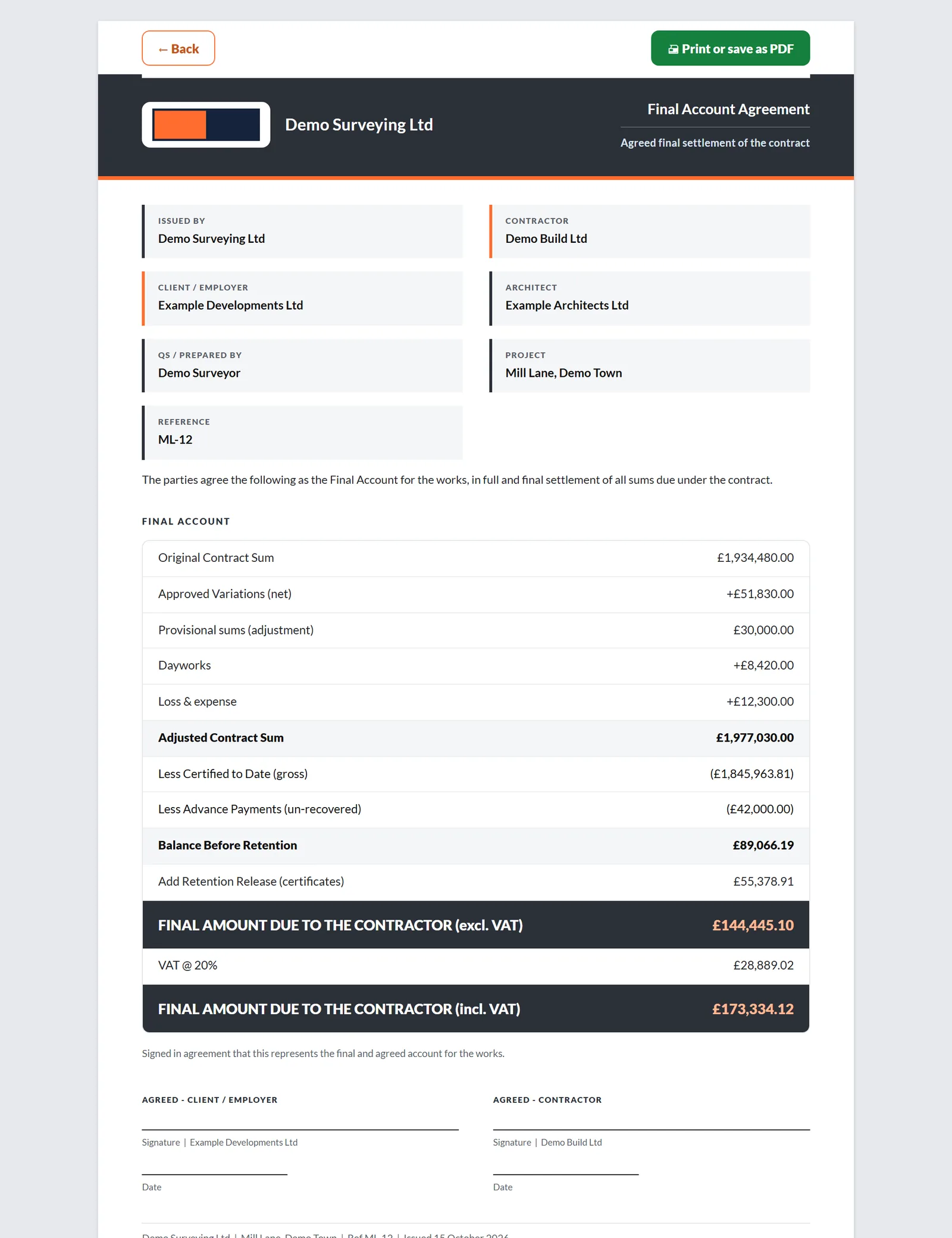
Every adjustment from the original contract sum to the final balance due, in the order RICS sets out, so the client can follow it without a covering letter explaining the spreadsheet.
30 days free, no card.
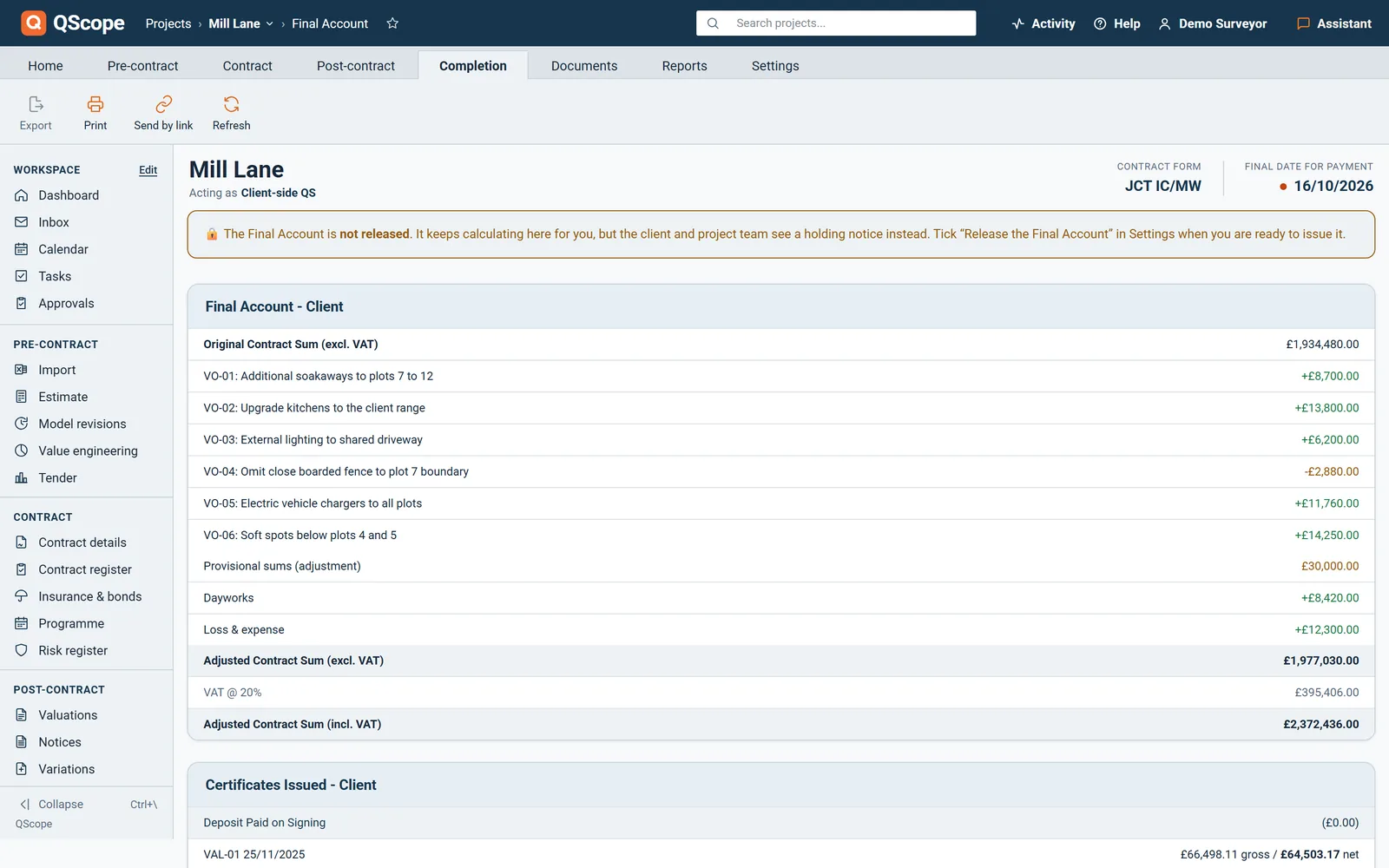
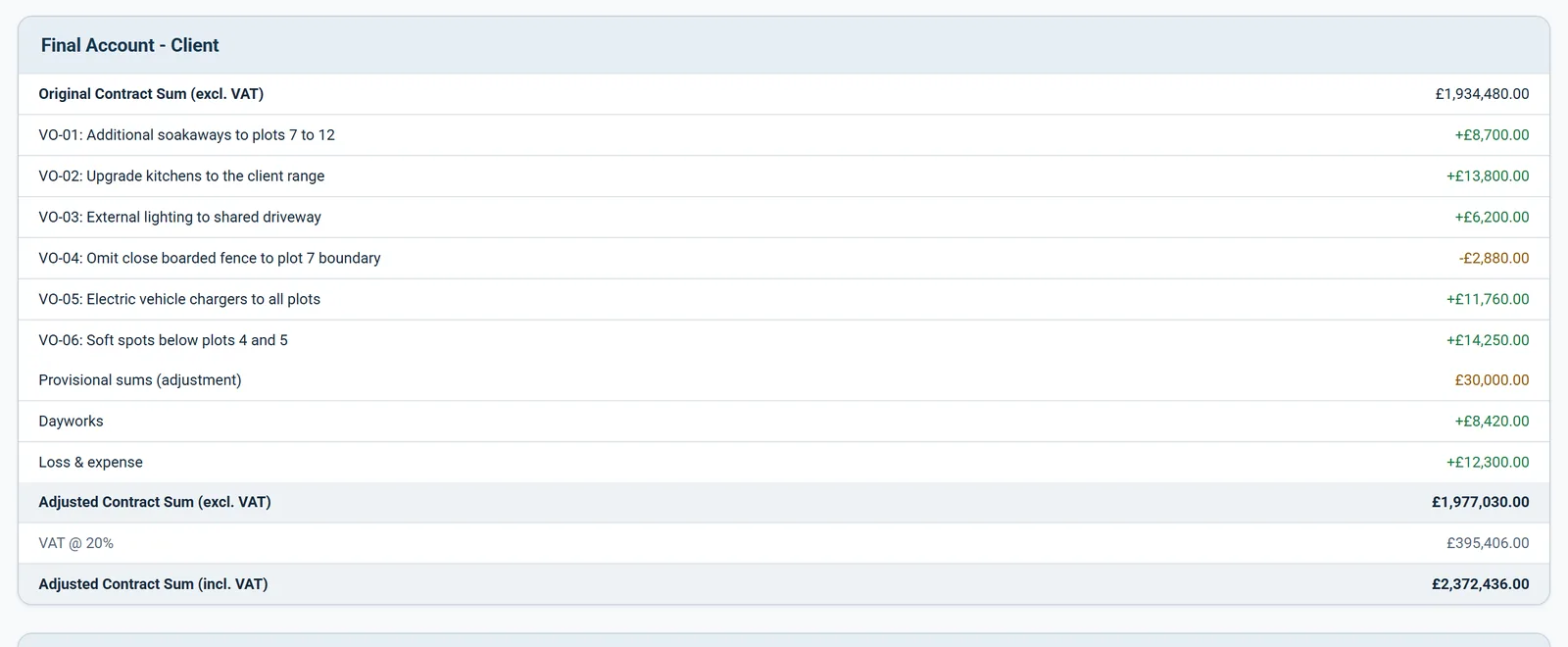
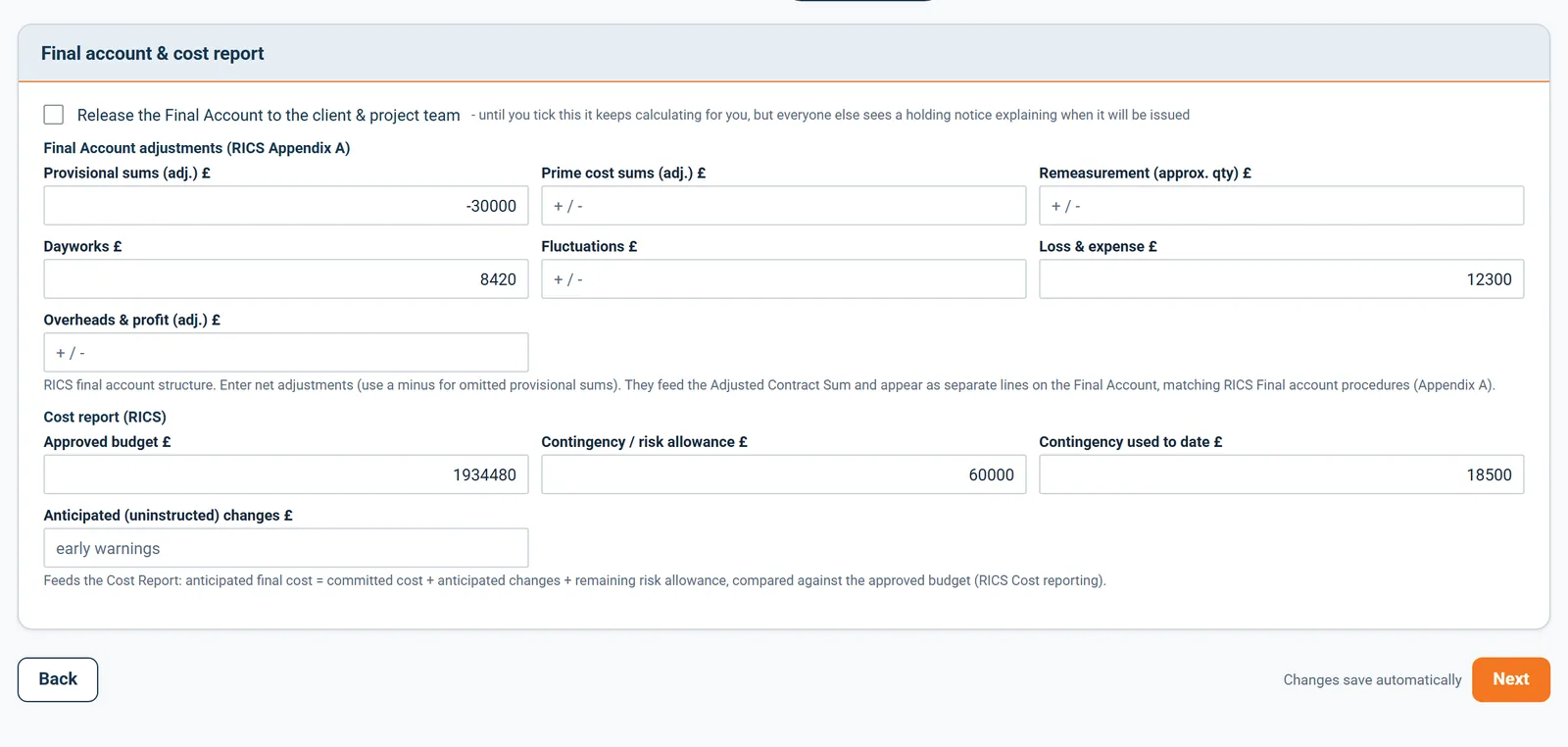
QScope lays out the ladder: original sum, variations, omissions, provisional sums, remeasurement, dayworks, fluctuations and loss and expense, then what has been certified and what remains.
The argument at final account is almost never about the total.
It is about one adjustment the client did not expect and cannot trace. QScope lays out the ladder: original sum, variations, omissions, provisional sums, remeasurement, dayworks, fluctuations and loss and expense, then what has been certified and what remains.
Final Account
The argument at final account is almost never about the total.
QScope lists each category on its own line, in the order RICS sets out, and prints only the ones that are not zero so the statement stays readable.
Variations
The £1,000 for variations on the account is not a lump.
QScope carries the approved variations into the adjusted contract sum and keeps the basis of valuation behind each one, so a challenged adjustment can be traced to its clause and its instruction.
Retention
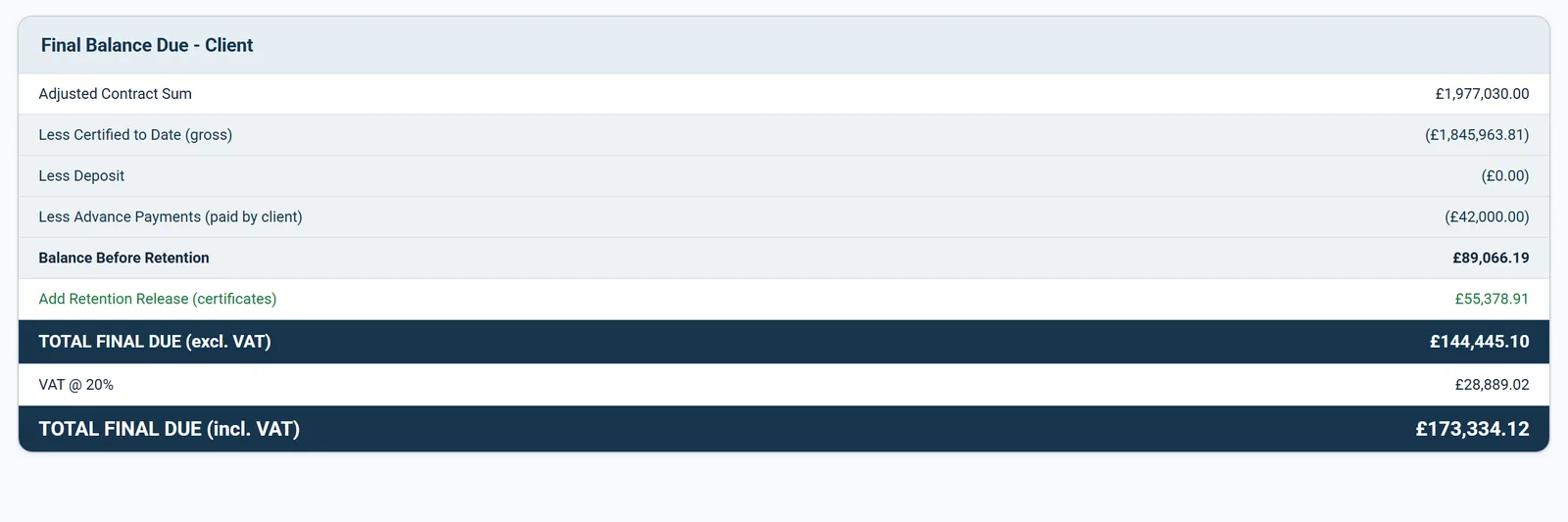
Certified to date is deducted gross at £84,115, because retention has not been paid yet.
QScope carries the retention through as an explicit release, matching the retention notice, so the client can see the security returned rather than quietly netted off.
Loss and expense
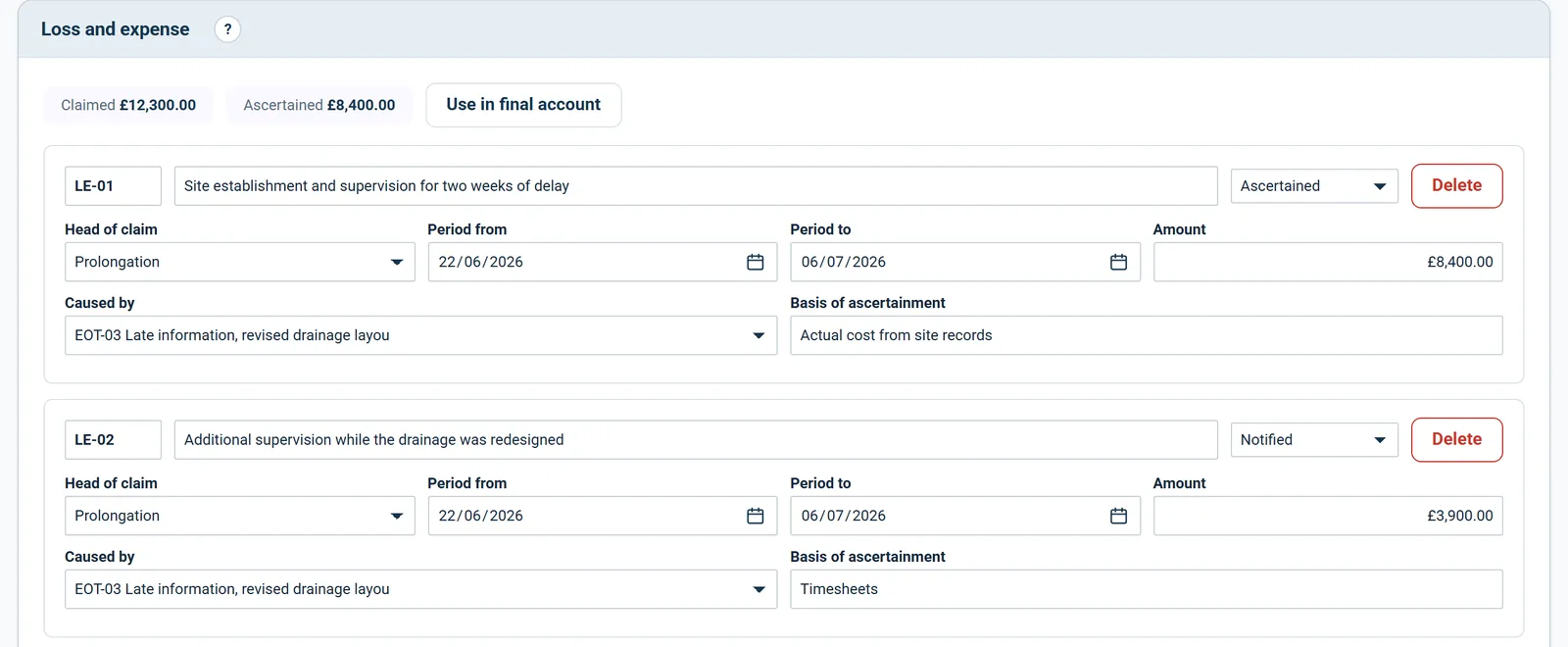
Loss and expense is not subject to retention and it is not a variation.
QScope carries the ascertained total to the account on its own line, each head linked to the delay event it arose from, so the client sees what was allowed and on what basis.
Final account
A FIDIC job does not close on a JCT final certificate.
On the 1999 Red Book the Engineer certifies within 28 days and the Employer pays within 56 days of the Statement, counted in calendar days. No pay-less notice applies. Dates and taxes are published starting points to verify locally.
Who it is for
You are applying
You build the account from evidenceYou build the final account from every adjustment on the record, and argue it from evidence rather than memory.
Applying for paymentYou are certifying
You settle it, deduction by deductionYou settle the account from the other chair, and every deduction has to trace back to an instruction, a valuation or a notice.
Certifying paymentYou are doing both
You close a year of paper aloneYou agree the final account yourself, a year of paperwork against a client who remembers it differently.
Doing both yourselfYou are reporting
You sign off before the facility closesYou confirm the final position before the facility closes: retention released, variations settled, the account signed off.
Recommending a drawdownThe client, the architect and the tenderer are not on this list. They are the people you let in on a link: they see the one document you sent them, answer it, and that answer is written into the record. No account, no licence, no charge, on every plan.
The questions this page raises most often, answered without a sales pitch at the end.
Yes. Omitted work carries through as a negative adjustment, and provisional sums, remeasurement, dayworks, fluctuations and loss and expense each have their own line so the client can see what moved and why.
Because retention has not been paid yet, so it is added back on the next line as a release. Deducting net would quietly lose the retention from the account. The statement shows both steps rather than hiding the arithmetic.
That is the point of it. Anticipated final cost against the approved budget is available from the first valuation, and the variance is shown as a figure rather than a colour, so it survives being printed in black and white.
Enter their purchase order or reference in the project settings and it prints on certificates and reports, so their accounts team can match it without emailing you.
Yes. On a FIDIC contract the account closes through the Statement at completion, the Final Statement and the Final Payment Certificate under Sub-Clauses 14.11 to 14.13, with the Engineer certifying within 28 days and the Employer paying within 56, counted in calendar days. The statutory dates and taxes shown are published starting points to verify locally.
From the blog
Three pieces from the same corner of a contract as this page, answered at length and without a sales pitch at the end.
No. There is no rule of law that finished work earns a discount, and the request usually works only because the builder is tired and the retention is hostage. How to price a concession properly if you choose to make one, and what never to trade away.
Read nowOn many standard forms the final certificate is not just the last payment: after a short window passes, it becomes conclusive evidence on the account, in both directions. The window is weeks, it is in your particulars, and it does not care whether you noticed it.
Read nowWhen an employer terminates for contractor default, the reckoning that follows weighs cost of completion and damages against what the contractor would have been due. It is a different exercise from a final account.
Read nowKeep reading
Every adjustment from the original contract sum to the final balance due, in the order RICS sets out, so the client can follow it without a covering letter explaining the spreadsheet.
30 days free, no card.
Rather ask first? Write to help@qscope.co.uk and you will get a reply within one working day, Monday to Friday.